
Table of Contents
The Square of Opposition is a classic logic diagram that connects four statements: A, E, I, O.
It tells you which statements can be true together, which cannot, and what must follow when one is true or false.
This topic becomes easy when you first learn the four forms and then learn the four relations between them.
In Real Life: People use “all”, “none”, “some”, “not all” daily, and small wording changes completely change the meaning.
Exam Point of View: Questions usually test relation-names, “which must be true/false”, and traditional vs modern interpretation.
1. Categorical Propositions and A/E/I/O Forms
1.1 What a categorical proposition means
A categorical proposition is a statement about a group or class.
It connects a Subject class (S) with a Predicate class (P) using words like all, no, some.
The Square of Opposition is built only on these four standard patterns.
1.2 The four standard forms with meaning
| Form | Standard pattern | Quantity | Quality | Simple example |
|---|---|---|---|---|
| A | All S are P | Universal | Affirmative | All teachers are educated |
| E | No S are P | Universal | Negative | No teachers are robots |
| I | Some S are P | Particular | Affirmative | Some teachers are strict |
| O | Some S are not P | Particular | Negative | Some teachers are not strict |
1.3 Quick identification words (high scoring)
- A-form: all, every, each, always (when it means “for all”)
- E-form: no, none, never (when it means “for no one”)
- I-form: some, at least one, a few, many (when it means “exists”)
- O-form: some not, not all, at least one not, few are not
1.4 One-line conversion rules (very common traps)
- “Not all S are P” becomes “Some S are not P” which is O.
- “Only S are P” becomes “All P are S” which is an A form with reversed terms.
- “None but S are P” also becomes “All P are S”.
2. Traditional Square of Opposition and the Four Relations
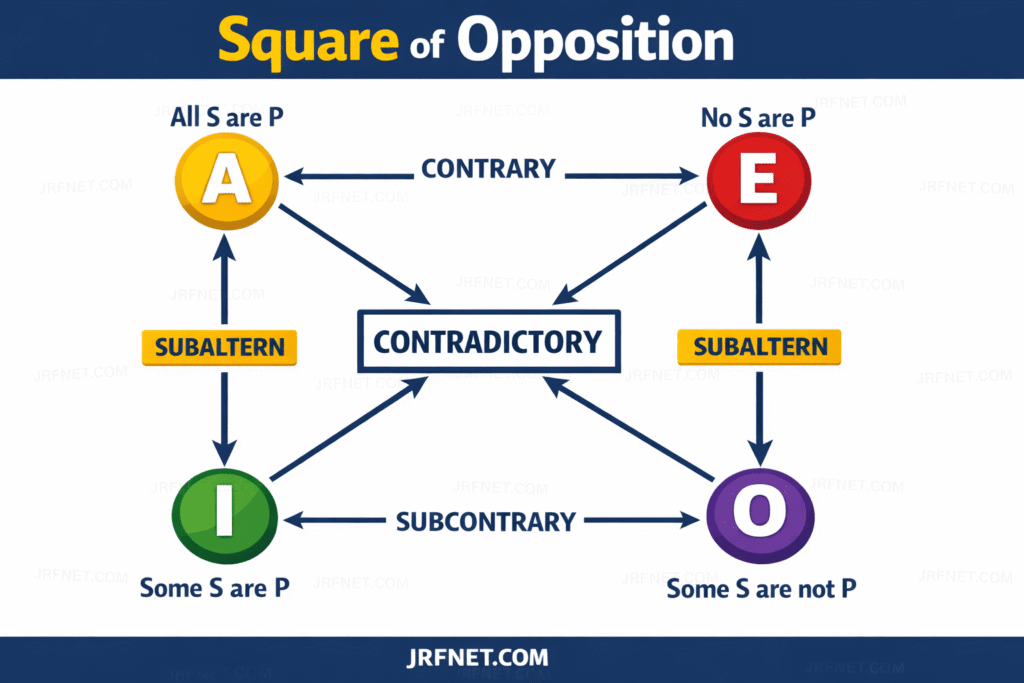
2.1 How the square is arranged
- A at top-left: All S are P
- E at top-right: No S are P
- I at bottom-left: Some S are P
- O at bottom-right: Some S are not P
Between these four, we talk about four relations.
2.2 Contradictory relation (strongest relation)
Contradictory means two statements cannot both be true and cannot both be false.
So if one is true, the other must be false, always.
- A is contradictory to O
- E is contradictory to I
Situational Example: If a teacher says “All students submitted the assignment” (A) and you find even one student who did not submit, then A becomes false and O becomes true.
2.3 Contrary relation
Contrary means two statements cannot both be true, but they can both be false.
- A and E are contraries
So:
- If A is true, E must be false
- If E is true, A must be false
- If one is false, the other may or may not be true
2.4 Subcontrary relation
Subcontrary means two statements cannot both be false, but they can both be true.
- I and O are subcontraries
So:
- If I is false, O must be true
- If O is false, I must be true
- If one is true, the other may or may not be true
2.5 Subalternation relation
Subalternation is a “truth-flow” relation between universal and particular.
- A is the superaltern of I
- E is the superaltern of O
Traditional rule:
- If A is true, I must be true
- If E is true, O must be true
- If I is false, A must be false
- If O is false, E must be false
Exam Point of View: Many options look tempting, but only contradictory conclusions are always guaranteed even when the question is tricky, so start with contradictory pairs first.
3. Truth and Falsity Flow Rules You Must Know
3.1 Guaranteed results when A is given
- If A is true, then E is false, I is true, O is false
- If A is false, then O is true
3.2 Guaranteed results when E is given
- If E is true, then A is false, I is false, O is true
- If E is false, then I is true
3.3 Guaranteed results when I is given
- If I is false, then E is true and O is true and A is false
- If I is true, then E must be false, but A and O are not forced
3.4 Guaranteed results when O is given
- If O is false, then A is true and I is true and E is false
- If O is true, then A must be false, but E and I are not forced
3.5 One compact guarantee table
| Given | Must be true | Must be false |
|---|---|---|
| A is true | I | E, O |
| A is false | O | |
| E is true | O | A, I |
| E is false | I | |
| I is false | E, O | A |
| O is false | A, I | E |
4. Modern Interpretation and Existential Import
4.1 What existential import means
Existential import is an academic term, meaning a statement assumes that the subject class actually exists.
In simple words, it assumes there is at least one S in real life.
Traditional logic often treats universal statements like A and E as if S exists.
Modern logic does not automatically assume this.
4.2 Why modern logic changes some relations
If S does not exist, universal statements can become “vacuously true”, meaning true only because there is no counterexample.
In simple words, if there are no S at all, “All S are P” cannot be proven wrong by any S, so it can be treated as true.
Because of this, in modern interpretation:
- Subalternation is not always safe
- Contrary and subcontrary are not always safe
- Contradictory pairs remain safe
4.3 What remains always valid (most important for UGC NET)
Always safe relations:
- A is contradictory to O
- E is contradictory to I
When the exam mentions modern interpretation or uses imaginary subjects, trust only contradictions for guaranteed answers.
5. Quick Recognition and PYQ-Style Traps
5.1 How to solve any square question in a clean method
- Step 1: Convert the sentence into A, E, I, or O form
- Step 2: Identify whether the question is asking contradictory, contrary, subcontrary, or subaltern
- Step 3: Write only what must follow, not what may follow
- Step 4: If modern interpretation is mentioned, stick to contradictory results first
5.2 Common trap statements and correct standard form
- “Not all teachers are punctual” becomes O
- “Only honest people are trusted” becomes “All trusted people are honest” which is A with reversed terms
- “Some students are not absent” becomes I, because “not absent” becomes a positive class “present”
5.3 Typical question patterns you should expect
- Identify the relation between two given forms
- Given one form is true or false, choose the statement that must be true or must be false
- Convert an English sentence and pick A, E, I, or O
- Traditional vs modern interpretation selection
Key Points – Takeaways
- Square of Opposition connects four categorical forms: A, E, I, O.
- A means All S are P, E means No S are P, I means Some S are P, O means Some S are not P.
- Contradictory pairs are A–O and E–I, and they are the strongest guaranteed relations.
Exam Point of View: If you are stuck, jump to contradictory first because it always gives a forced answer.
- A–E are contraries, so they cannot both be true.
- I–O are subcontraries, so they cannot both be false.
- Subalternation means A implies I and E implies O in traditional logic.
Exam Point of View: If modern interpretation is mentioned, do not use subalternation as a guaranteed inference.
- “Not all S are P” is always O form.
- “Only S are P” is a reversal trap and becomes “All P are S”.
- When a statement is false, do not assume the opposite corner is true unless it is a contradictory pair.
Exam Point of View: Many options show “may be true”, but the correct answer is usually the one that “must be true”.
Examples
Example 1
Statement: All students are punctual.
This is an A-form statement. Its contradictory is O-form: Some students are not punctual.
If you find one student who is not punctual, A becomes false and O becomes true.
Example 2
Statement: No professors are careless.
This is an E-form statement. Its contradictory is I-form: Some professors are careless.
If you can prove even one professor is careless, E becomes false and I becomes true.
Example 3
Statement: Some teachers are strict.
This is an I-form statement. Its contradictory is E-form: No teachers are strict.
If “No teachers are strict” is true, then “Some teachers are strict” must be false.
Example 4
Statement: Not all mobile apps are free.
This converts into O-form: Some mobile apps are not free.
Its contradictory is A-form: All mobile apps are free, which becomes false if even one paid app exists.
Example 5
Statement: All unicorns are animals.
This is A-form, but unicorns may not exist.
In modern interpretation, you should not jump to “Some unicorns are animals”, because existence is not guaranteed.
Quick One-shot Revision Notes
- A means universal affirmative and uses “all”.
- E means universal negative and uses “no”.
- I means particular affirmative and uses “some”.
- O means particular negative and uses “some not” or “not all”.
- Contradictory pairs are A–O and E–I.
- Contrary pair is A–E.
- Subcontrary pair is I–O.
- Subalternation links A to I and E to O in traditional logic.
- A true forces I true, E false, O false.
- E true forces O true, A false, I false.
- A false forces O true.
- E false forces I true.
- Modern interpretation keeps contradictions safest.
- “Only S are P” becomes “All P are S”.
- “Not all S are P” becomes “Some S are not P”.
Mini Practice
Q1) “Not all researchers are unbiased.” Which form is it?
A) A
B) E
C) I
D) O
Answer: D
Explanation: “Not all S are P” converts to “Some S are not P”, which is O-form.
Q2) Which pair is contradictory in the square?
A) A and E
B) I and O
C) A and O
D) A and I
Answer: C
Explanation: A and O are contradictory, so exactly one is true and the other is false.
Q3) If E is true, which statement must be false?
A) A
B) O
C) Both A and I
D) I
Answer: C
Explanation: E contradicts I, so I must be false, and E is contrary to A, so A must be false.
Q4) If A is false, what must be true?
A) E
B) I
C) O
D) E and I
Answer: C
Explanation: A and O are contradictory, so A false forces O true.
Q5) Assertion (A): In modern logic, “All S are P” does not always imply “Some S are P.” Reason (R): Modern logic does not assume existence in universal statements.
A) Both A and R are true, and R explains A
B) Both A and R are true, but R does not explain A
C) A is true, R is false
D) A is false, R is true
Answer: A
Explanation: Without assuming existence, “All S are P” can be treated as true even when no S exists, so “Some S are P” is not guaranteed.
FAQs
What is the Square of Opposition?
It is a diagram showing truth-relations among A, E, I, O categorical propositions.
Which relations are always safe in modern interpretation?
Contradictory relations: A–O and E–I.
What does “Not all S are P” mean in standard form?
It means “Some S are not P”, which is O-form.
Why is “Only S are P” tricky?
It reverses terms and means “All P are S”, not “All S are P”.
What is existential import in simple words?
It means assuming the subject class exists, even if the sentence does not say it.
Can I use subalternation in every question?
Use it only when the question follows traditional interpretation and existence is not doubtful.