
Table of Contents
Categorical propositions are short “All/No/Some” type statements that connect two groups using logic.
They look simple, but a single word like “all” or “some” changes the meaning and the exam answer.
When you learn A/E/I/O forms plus distribution, you can solve many Square of Opposition questions quickly.
In Real Life: We say “All students are sincere” or “Some people are rude” daily, but we rarely check what those words logically guarantee.
Exam Point of View: NET questions often test two skills together, identify A/E/I/O and apply distribution or square relations without getting trapped.
1. Categorical Propositions – Forms, Terms and Meaning
1.1 Parts of a categorical proposition
A standard categorical proposition has three parts.
- Subject term (S) means the group we talk about
- Copula means the linking word like “are” or “are not”
- Predicate term (P) means the group we connect S with
Example: “All students are learners.”
Here “students” is S, “are” is the copula, and “learners” is P.
1.2 Quantity and quality
Every categorical proposition has two key features.
- Quantity means how much of the subject class is included
- Universal means the statement talks about the whole S group
- Particular means the statement talks about at least one member of S
- Quality means whether the statement affirms or denies
- Affirmative means it says S is included in P
- Negative means it says S is excluded from P
1.3 The four standard forms A, E, I, O
These four forms are the base for distribution and the Square of Opposition.
| Form | Standard pattern | Quantity | Quality | Simple example |
|---|---|---|---|---|
| A | All S are P | Universal | Affirmative | All dogs are animals |
| E | No S are P | Universal | Negative | No dogs are cats |
| I | Some S are P | Particular | Affirmative | Some dogs are friendly |
| O | Some S are not P | Particular | Negative | Some dogs are not pets |
Important meaning rule: “some” means “at least one.” It never means “many” in logic.
1.4 Universal vs particular in real sentences
Universal statements talk about the complete subject group.
- All, every, each, any, always, none, no one
Particular statements talk about at least one member.
- Some, at least one, a few, several, many, not all
Be careful: “not all S are P” is logically the same as “some S are not P,” so it becomes an O form.
1.5 Affirmative vs negative in real sentences
Affirmative statements connect S inside P.
- “All S are P”
- “Some S are P”
Negative statements separate S from P.
- “No S are P”
- “Some S are not P”
1.6 Converting English statements into standard A/E/I/O form
This is a high-yield skill because NET uses natural language, not always clean “All/No/Some.”
Common translations that NET uses
- “Only P are S” becomes “All S are P” after rearranging the classes correctly
Example: “Only teachers are eligible” means “All eligible people are teachers” - “None but P are S” also means “All S are P”
Example: “None but doctors are surgeons” means “All surgeons are doctors” - “Not all S are P” becomes “Some S are not P”
- “Some S are non-P” becomes “Some S are not P”
Exam Point of View: The word “only” is a frequent trap because it reverses the direction of the statement if you translate it casually.
2. Distribution of Terms – Rules, Table and Exam Tricks
2.1 Meaning of distribution in the simplest way
Distribution is an academic word meaning “the statement talks about the whole class.”
So a term is distributed when the proposition refers to every member of that term.
If you say “All students are learners,” you are talking about every student, but you are not talking about every learner.
2.2 Two shortcut rules that work every time
You do not need to memorize four separate cases if you remember these two rules.
- Universal statements distribute the subject term (S)
- Negative statements distribute the predicate term (P)
Now you can fill the entire distribution table in seconds.
2.3 Distribution quick table for A/E/I/O
| Form | Pattern | S distributed | P distributed |
|---|---|---|---|
| A | All S are P | Yes | No |
| E | No S are P | Yes | Yes |
| I | Some S are P | No | No |
| O | Some S are not P | No | Yes |
2.4 Why predicate is not distributed in affirmative forms
In “All S are P,” we only claim that the S group lies inside P.
We never claim that the entire P group is only S, so P is not fully covered.
This single idea prevents a common mistake where students mark P distributed in A.
2.5 Typical NET mistakes in distribution
- Treating “All S are P” as if it says “All P are S”
- Forgetting that negative statements distribute P in both E and O
- Thinking “some” distributes S, which is never true in I and O
Exam Point of View: If you are confused, use the two shortcut rules again instead of guessing from memory.
2.6 How distribution connects to common syllogism fallacies
This point helps you later when you study categorical syllogisms.
- If a term is distributed in the conclusion, it must be distributed in its premise
- If the middle term is never distributed in any premise, the argument usually fails
These ideas create classic errors like “illicit major,” “illicit minor,” and “undistributed middle,” which NET often tests.
3. Classical Square of Opposition – Relations and What You Can Infer
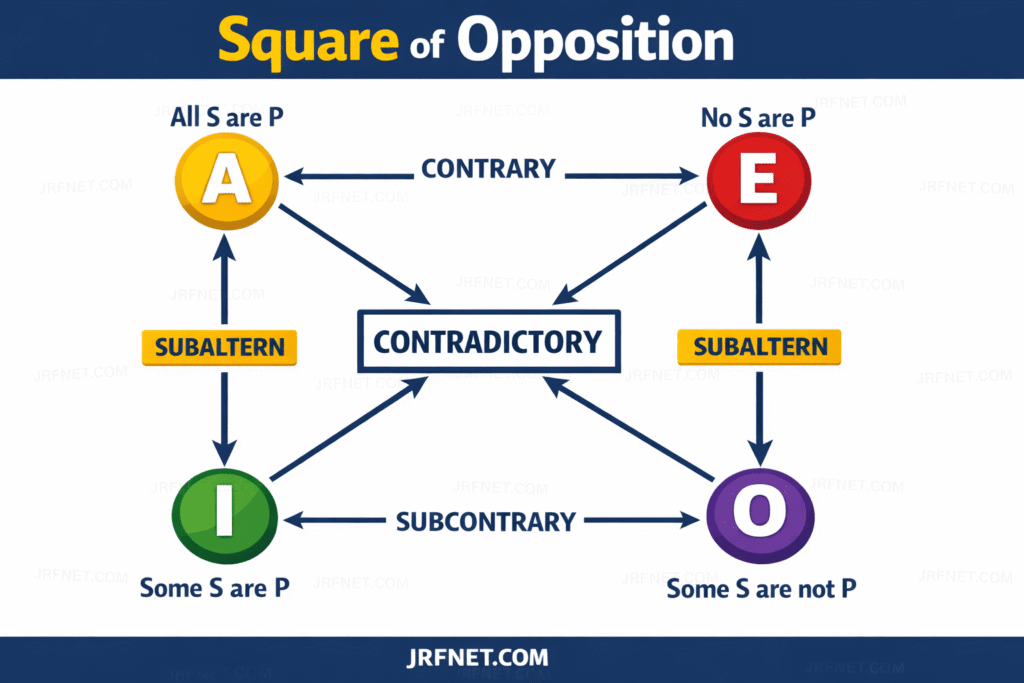
3.1 The classical square layout
The square arranges A, E, I, O in a fixed pattern.
- A is universal affirmative
- E is universal negative
- I is particular affirmative
- O is particular negative
A and E stay on top because they are universal.
I and O stay at the bottom because they are particular.
3.2 Contradictory relation
Contradictories are the diagonal pairs.
- A and O are contradictories
- E and I are contradictories
Meaning: one must be true and the other must be false.
If A is true, O must be false.
If O is true, A must be false.
The same logic works for E and I.
3.3 Contrary relation
Contraries are A and E.
- They cannot both be true
- They can both be false
So if A is true, E is definitely false.
But if A is false, E may be true or false, so you cannot conclude immediately.
3.4 Subcontrary relation
Subcontraries are I and O.
- They cannot both be false
- They can both be true
So if I is false, O must be true.
But if I is true, O may be true or false.
3.5 Subalternation relation
Subalternation is the vertical relation.
- A implies I
- E implies O
Meaning: if a universal statement is true, its particular version below it is also true.
This relies on an existence assumption, which becomes important in modern interpretation.
3.6 Quick inference table for truth and falsity
This table helps in direct NET questions like “If A is true, what must be true or false.”
| Given statement | Must be true | Must be false | Cannot be decided |
|---|---|---|---|
| A true | I true | O false, E false | none |
| A false | O true | none | E, I |
| E true | O true | I false, A false | none |
| E false | I true | none | A, O |
| I true | none | E false | A, O |
| I false | E true | none | A, O |
| O true | none | A false | E, I |
| O false | A true | none | E, I |
Use this table only when the question clearly uses the traditional square.
4. Traditional vs Modern Interpretation – Existential Import and NET Notes
4.1 What existential import means
Existential import is an academic term meaning “the subject class exists.”
In simple words, it assumes there is at least one S in reality.
Traditional logic usually assumes existence for universal statements.
Modern Boolean logic does not assume existence automatically.
4.2 Why modern logic changes some square relations
Modern logic allows a universal statement to be true even if S has no members.
This idea is called “vacuous truth,” which means “true because nothing violates it.”
If there are no unicorns, then “All unicorns are white” becomes true in modern logic because there is no unicorn to disprove it.
4.3 Which relations remain safe in modern logic
In modern interpretation, the safest and always-valid relations are the contradictories.
- A with O
- E with I
The relations involving subalternation and the top or bottom lines can fail when S is an empty class.
Exam Point of View: If the question uses words like “Boolean,” “modern view,” or “without existential import,” apply only contradictory relations unless existence is clearly stated.
4.4 Keywords NET uses to signal modern interpretation
- Boolean interpretation
- modern square
- empty class
- existential import not assumed
- vacuous truth
When you see these words, avoid using subalternation as a guaranteed inference.
5. NET Solving Method – Identify Form, Mark Distribution, Apply Relation
5.1 Five-step method that saves time
Step 1: Convert the sentence into a clean A/E/I/O pattern using All, No, Some, Some not.
Step 2: Identify quantity and quality, then label it as A, E, I, or O.
Step 3: Mark distribution using the two shortcut rules or the table.
Step 4: If a square relation is asked, apply the correct relation carefully.
Step 5: If modern logic is mentioned, trust only the contradictory pairs unless existence is given.
Situational Example: If you are told “All athletes are disciplined,” you mark it as A, then immediately you know “Some athletes are not disciplined” must be false because it is the O form contradictory.
Key Points – Takeaways
- A categorical proposition connects two classes using S and P.
- Quantity tells universal or particular.
- Quality tells affirmative or negative.
- A, E, I, O are the only four standard forms.
Exam Point of View: Many wrong answers happen because students confuse “not all” with “some.” Always convert “not all S are P” into O form.
- “Some” means at least one, not many.
- Universal statements distribute the subject term.
- Negative statements distribute the predicate term.
- A distributes only S, E distributes both, I distributes none, O distributes only P.
Exam Point of View: If you remember just two lines, you can rebuild the full distribution table during the exam.
- Contradictories are diagonal pairs A with O and E with I.
- A and E are contraries, I and O are subcontraries.
- Subalternation is A to I and E to O in traditional logic.
- Modern logic may break subalternation if the subject class is empty.
Exam Point of View: If modern or Boolean is mentioned, do not force “A implies I” unless the question clearly states that S exists.
Examples
Example 1
“All teachers are educated.”
This is A form because it is universal and affirmative.
It talks about every teacher, so S is distributed.
It does not talk about every educated person, so P is not distributed.
Example 2
“No corrupt officials are honest.”
This is E form because it is universal and negative.
It covers every corrupt official, so S is distributed.
It also denies the entire predicate class for that subject, so P is distributed.
Example 3
“Some students are athletes.”
This is I form because it is particular and affirmative.
It does not talk about all students, so S is not distributed.
It does not talk about all athletes, so P is not distributed.
Example 4
“Some smartphones are not expensive.”
This is O form because it is particular and negative.
The subject is not distributed because it refers to only some smartphones.
The predicate is distributed because a negative statement distributes P.
Example 5
A principal claims, “All project groups submitted on time.”
A class monitor says, “One group did not submit.”
If the monitor is correct, the principal’s A statement becomes false.
Then the O statement “Some project groups are not submitted on time” becomes true.
This is exactly how contradictory pairs behave in the square.
Example 6
Statement: “Not all candidates are qualified.”
This is not an A form even though it mentions “all.”
It actually means “Some candidates are not qualified,” which is an O form.
This conversion is a frequent NET pattern.
Quick One-shot Revision Notes
- Categorical proposition uses classes and works in S–P form.
- Quantity can be universal or particular.
- Quality can be affirmative or negative.
- A means all S are P.
- E means no S are P.
- I means some S are P.
- O means some S are not P.
- Universal distributes S.
- Negative distributes P.
- A distributes only S.
- E distributes both S and P.
- I distributes neither S nor P.
- O distributes only P.
- Contradictories are A with O and E with I.
- Traditional square supports contrary, subcontrary, subalternation relations.
- Modern interpretation keeps contradictories safest when existence is not assumed.
Mini Practice
Q1) Identify the form of the statement, “Some students are not punctual.”
A) A
B) E
C) I
D) O
Answer: D
Explanation: “Some” with “not” gives a particular negative statement, which is O form.
Q2) Which pair is contradictory in the Square of Opposition.
A) A and E
B) I and O
C) A and O
D) A and I
Answer: C
Explanation: Contradictory relations are diagonal pairs, so A and O are contradictories.
Q3) In the statement “All S are P,” which term is distributed.
A) Only S
B) Only P
C) Both S and P
D) Neither S nor P
Answer: A
Explanation: Universal distributes the subject, and affirmative does not distribute the predicate.
Q4) If E is true, “No S are P,” which statement must be false.
A) A
B) I
C) O
D) Cannot be decided
Answer: B
Explanation: E and I are contradictories, so if E is true, I must be false.
Q5) Assertion (A): In modern Boolean interpretation, subalternation is not always valid. Reason (R): Modern logic does not assume existential import for universals.
A) Both A and R are true and R explains A
B) Both A and R are true but R does not explain A
C) A is true but R is false
D) A is false but R is true
Answer: A
Explanation: Without existence, a universal statement can be true while the corresponding particular statement can be false, so subalternation fails.
FAQs
What is a categorical proposition in simple words
It is an All, No, or Some type statement that links two groups, called S and P.
What does distribution mean
Distribution means the statement talks about the whole class of a term, not just part of it.
Which forms distribute the predicate term
Negative forms distribute the predicate, so E and O distribute P.
Which relations are always safe in modern interpretation
Contradictory relations A with O and E with I remain valid even without assuming existence.
Why is “only” a trap word
Because “Only P are S” usually converts to “All S are P” after correct rearrangement.
What is existential import
It is the assumption that the subject class exists, meaning at least one S is present in reality.