
UGC NET Paper 1 Unit 6 (Logical Reasoning) trains your brain to think clearly and judge statements logically.
This unit is not about “guessing”; it is about using rules to check whether a conclusion really follows.
You will learn arguments, reasoning types, analogies, Venn diagrams, and key parts of Indian Logic.
If you master this unit, you can quickly eliminate wrong options and save time in Paper 1.
In Real Life: You use logical reasoning when you decide whether a claim on social media is believable or not.
Exam Point of View: Questions often look simple, but the trap is confusing “truth” with “validity” and mixing deductive with inductive logic.
What is Logical Reasoning
Logical Reasoning means thinking in a rule-based way to reach a conclusion from given statements.
In simple words, it helps you check: “Does this conclusion really come from these facts?”
This unit is important in Paper 1 because it directly improves your accuracy in reasoning-based questions.
It also strengthens comprehension and decision-making, because you learn how language, evidence, and logic connect in an argument.
Scope of Logical Reasoning in UGC NET Paper-1
What this unit covers
- How arguments are built (premises and conclusion) and how to test them
- Deductive reasoning (certain conclusion) vs inductive reasoning (probable conclusion)
- Analogies (relationship-based thinking)
- Venn diagrams for checking validity of statements
- Indian Logic basics: means of knowledge (Pramanas), inference (Anumana), Vyapti, and Hetvabhasas
What this unit does not cover
- Heavy mathematical calculations (that belongs more to Unit 5)
- Subject-specific logic of Paper 2 (your chosen subject)
- Advanced formal logic topics like modal logic, symbolic proof systems, or Boolean algebra in depth
- Programming logic or computer-science algorithms
Official Syllabus Topics of Logical Reasoning
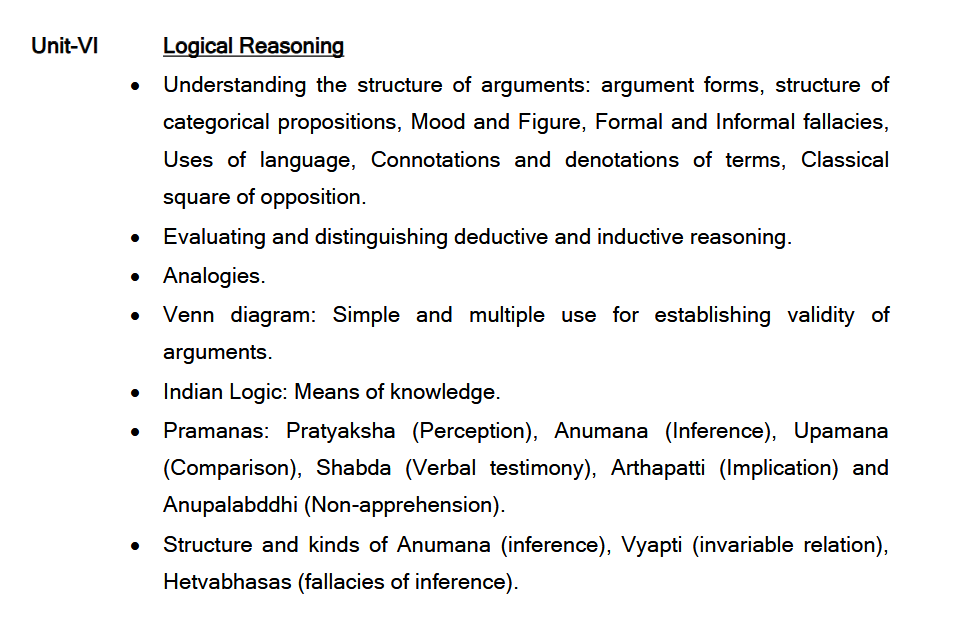
The official Paper 1 syllabus is published on the UGC NET syllabus portal, and NTA bulletins direct candidates to use this portal for syllabi.
| Official Syllabus Topic | What you should study |
|---|---|
| Understanding the structure of arguments: argument forms, categorical propositions, Mood and Figure, Formal and Informal fallacies, Uses of language, Connotations and denotations of terms, Classical square of opposition | Learn premise–conclusion structure, proposition types, syllogism basics, fallacy spotting, and meaning of terms in context. |
| Evaluating and distinguishing deductive and inductive reasoning | Practice identifying “guaranteed vs probable” conclusions and selecting the correct reasoning type. |
| Analogies | Learn relationships (part–whole, cause–effect, function, sequence) and test options by relationship consistency. |
| Venn diagram: Simple and multiple use for establishing validity of arguments | Use Venn shading/marking to check whether statements can be true together and whether conclusions follow. |
(Topics extracted from the official Paper-I syllabus PDF, Unit-VI Logical Reasoning.)
Weightage and PYQ Trend
Paper 1 is designed unit-wise, and the official note says 5 questions (2 marks each) are set from each unit (module), so Unit 6 typically contributes around 10 marks.
Most repeated micro-topics
- Argument basics: premise, conclusion, inference, assumption
- Deductive vs Inductive (identify type + pick correct conclusion strength)
- Fallacies (formal vs informal) and “flaw in reasoning” questions
- Categorical propositions + Square of Opposition basics
- Venn diagram validity checking (simple + 2–3 statement sets)
- Indian Logic: Pramanas (direct meaning + example)
- Anumana, Vyapti, Hetvabhasa (definition + identification)
Common question styles (match, statement-based, scenario, assertion–reason)
- Match the concept with example (e.g., Pramana → example)
- Statement-based: choose correct/incorrect statements
- Scenario-based: short paragraph, identify assumption/conclusion/fallacy
- Assertion–Reason: test whether reason supports assertion logically
- Diagram-based: Venn diagram or set-style validity
Unit Blueprint (Concept Map in Text Format)
- Argument Basics
1.1) Premise, Conclusion, Inference
1.2) Argument Forms
1.3) Uses of Language
1.4) Connotation vs Denotation - Categorical Logic (Classic)
2.1) Categorical Propositions (A/E/I/O)
2.2) Square of Opposition
2.3) Mood and Figure (intro level) - Reasoning Types
3.1) Deductive Reasoning (certain)
3.2) Inductive Reasoning (probable)
3.3) Evaluating strength of conclusion - Tools for Testing Validity
4.1) Venn Diagrams (simple)
4.2) Venn Diagrams (multiple statements) - Relationship Reasoning
5.1) Analogies (word/thing/relationship)
5.2) Choosing the closest relationship - Errors in Reasoning
6.1) Formal Fallacies (structure error)
6.2) Informal Fallacies (content/language error) - Indian Logic (High-Scoring Memory + Concept)
7.1) Means of Knowledge (Pramanas)
7.2) Anumana (Inference): structure + kinds
7.3) Vyapti (invariable relation)
7.4) Hetvabhasas (fallacies of inference)
Most Confusing Areas and Common Traps
1) Valid vs Sound (biggest trap)
A valid argument means the conclusion follows from the form (structure), even if facts are false.
A sound argument means it is valid and premises are actually true.
Exam Point of View: Many options mix “true conclusion” with “valid argument.” Always test structure first, truth second.
2) Deductive vs Inductive (certainty vs probability)
Deductive reasoning gives a conclusion that must be true if premises are true.
Inductive reasoning gives a conclusion that is likely true based on patterns or samples.
Situational Example: If a teacher checks only 5 notebooks and says “all students are careless,” that is inductive (sample → general).
3) Connotation vs Denotation (language trap)
Denotation is the direct dictionary meaning.
Connotation is the emotional or implied meaning (like “cheap” vs “affordable”).
Exam Point of View: If a question asks “use of language,” expect options around connotation/denotation and misleading words.
4) Formal vs Informal fallacies (structure vs content)
Formal fallacy = error in logical structure (form).
Informal fallacy = error due to language, relevance, weak evidence, or emotion.
How to Study Logical Reasoning (8 Day Plan)
Previous Year Question Styles from Logical Reasoning
- Argument identification (premise/conclusion)
Mini example: “Which statement is the conclusion in the argument?” - Deductive vs Inductive classification
Mini example: “This reasoning is based on sample observation. Identify the type.” - Fallacy / flaw-based questions
Mini example: “The speaker attacks the person, not the idea. Name the fallacy.” - Venn diagram validity questions
Mini example: “Using a Venn diagram, check if the conclusion follows.” - Analogy completion
Mini example: “Bird : Nest :: Bee : ?” - Indian Logic matching
Mini example: “Match Pramana with the correct example.”
Key Points – Takeaways
- Logical reasoning checks whether a conclusion follows from given statements.
- Separate “truth of statements” from “validity of argument.”
- Deductive = certain conclusion (if premises true).
- Inductive = probable conclusion (based on evidence/sample).
Exam Point of View: When two options look correct, pick the one that matches the “certainty level” (must vs likely).
- Connotation is implied meaning; denotation is direct meaning.
- Fallacies can be formal (structure error) or informal (content/language error).
- Venn diagrams help test validity visually, especially for categorical statements.
- Analogies are about relationship matching, not word matching.
Exam Point of View: In analogy questions, first name the relation (function, part–whole, cause–effect), then eliminate options.
- Indian Logic often asks Pramanas as direct definition + example.
- Anumana is inference; Vyapti is the fixed link between middle and major term (invariable relation).
- Hetvabhasa means “false reason” (fallacy of inference) in Indian Logic.
- Daily practice works best because reasoning is a skill, not only memory.
Exam Point of View: Unit 6 becomes easy when you practice mixed sets (argument + fallacy + Venn) instead of studying each topic in isolation.
Mini Practice (5 MCQs)
Q1 (Scenario-based):
A student says, “This teacher is wrong because he failed in his own exam years ago.” What is the error?
A) Straw man
B) Ad hominem
C) False cause
D) Appeal to authority
Answer: B
Explanation: The student attacks the person’s past, not the teacher’s current argument (ad hominem).
Q2 (Comparison/Difference):
Which statement best differentiates deductive and inductive reasoning?
A) Deductive is probable; inductive is certain
B) Deductive moves general→specific with certainty; inductive moves specific→general with probability
C) Both always guarantee true conclusions
D) Inductive depends only on definitions
Answer: B
Explanation: Deduction gives necessary conclusions (if premises true), induction gives likely conclusions based on evidence.
Q3 (Statement-based):
Choose the correct statement(s):
- A valid argument can have false premises.
- A sound argument must be valid and have true premises.
A) Only 1
B) Only 2
C) Both 1 and 2
D) Neither 1 nor 2
Answer: C
Explanation: Validity is about structure; soundness needs validity + true premises.
Q4 (Indian Logic):
Which Pramana refers to “verbal testimony” (trustworthy word/source)?
A) Pratyaksha
B) Shabda
C) Upamana
D) Anupalabddhi
Answer: B
Explanation: Shabda means knowledge gained through reliable verbal testimony/text.
Q5 (Venn/Validity idea):
Statement: “All A are B.” Conclusion: “Some B are A.” What is correct?
A) Always valid
B) Always invalid
C) Valid only if A exists
D) Valid only if B exists
Answer: C
Explanation: “All A are B” does not guarantee existence of A; “Some B are A” needs at least one A to exist.
FAQs
What is the easiest way to start Unit 6?
Start with premise–conclusion basics, then learn deductive vs inductive using simple daily-life examples.
Is Indian Logic really important for Unit 6?
Yes. Pramanas and Anumana-based MCQs are direct and scoring when learned with examples. Get INDIAN LOGIC Tutorials from here.
Do I need to master Mood and Figure deeply?
No. Learn the basic idea and common patterns; focus more on arguments, fallacies, and Venn validity.
Why do I make mistakes in fallacy questions?
Mostly due to reading fast. Identify the “reason” used (emotion, person attack, weak evidence) before choosing.
How many questions come from Logical Reasoning in Paper 1?
Typically 5 questions (2 marks each) from this unit, as Paper 1 is designed unit-wise.
How to improve Venn diagram accuracy?
Draw only what is given, use shading/marking rules, and check whether the conclusion must follow.