
Most Important Formulas for Mathematical Aptitude
Introduction
Unit 5 in UGC NET Paper 1 checks how quickly and clearly you can think with numbers and patterns.
It includes series, coding, relations, directions, and daily-life maths like percentage, profit-loss, interest, and time-work.
This unit becomes easy when you follow small steps and practice regularly.
Because questions repeat similar models, your score improves fast with correct practice.
In Real Life: You use these skills while shopping discounts, comparing prices, planning travel time, and splitting work with others.
Exam Point of View: Unit 5 rewards speed + accuracy, so daily practice is better than reading long theory once.
What is Mathematical Reasoning and Aptitude
Mathematical Reasoning means solving problems using logic (clear thinking) and patterns.
Aptitude means your ability to solve quickly using smart steps, not heavy maths.
This unit is important in Paper 1 because it tests your basic problem-solving ability.
If Unit 5 is strong, your overall Paper 1 time management becomes easier.
Scope of Mathematical Reasoning and Aptitude in UGC NET Paper-1
What this unit covers
- Pattern topics: Number Series, Alphabet / Letter Series
- Rule-based topics: Coding–Decoding
- Diagram-based topics: Blood Relations, Directions
- Core arithmetic: Averages, Fractions, Ages, Ratio & Proportion
- Percentage world: Percentages & Discounting
- Money maths: Profit & Loss, Simple Interest & Compound Interest
- Mixing models: Mixture & Alligation
- Time models: Time, Speed & Distance, Time & Work
What this unit does not cover
- Advanced algebra, calculus, or complex geometry proofs
- Trigonometry theorem-based problems
- Data Interpretation graphs (that comes under DI unit)
- Long statistics formulas
Official Syllabus Topics of Mathematical Reasoning and Aptitude
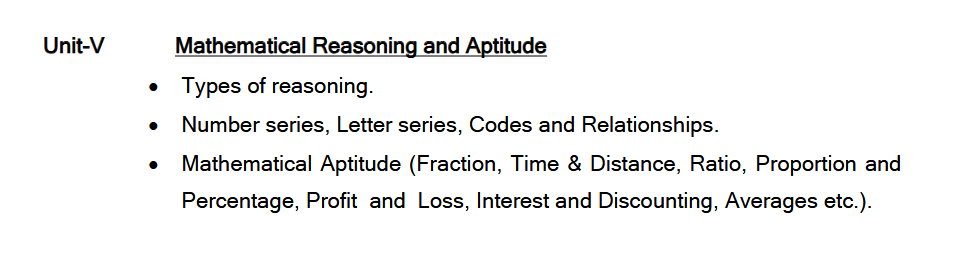
| Syllabus Topic | Questions Related to |
|---|---|
| Number Series | Find the missing/next number using patterns like differences, squares, alternates, or mixed rules. |
| Alphabet / Letter Series | Find missing/next letters using A=1…Z=26, reverse order, skipping, or position patterns. |
| Coding–Decoding | A word/number is changed by a hidden rule. Your job is to detect the rule and apply it. |
| Blood Relations | Family relationship questions. Best solved using a small family tree diagram. |
| Directions | Movement and turns (North/South/East/West). Best solved using arrows and quick sketches. |
| Averages | Average = total ÷ count. Used in marks, speeds, ages, and mixed arithmetic problems. |
| Fractions | Simplification, comparison, and conversion to decimals/percentages for quick calculations. |
| Ages | Present/past/future age problems. Mostly simple equations and time gaps. |
| Ratio & Proportion | Ratio compares quantities. Proportion checks equality of ratios. Used in sharing and comparisons. |
| Percentages & Discounting | Percent change, discount, successive discount, increase/decrease, and basic business maths. |
| Profit & Loss | CP/SP/MP based questions with profit%, loss%, discount%, marked price logic. |
| Simple Interest & Compound Interest | SI grows equally each year; CI grows faster because interest adds to principal. |
| Mixture & Alligation | Mix two values (price/strength). Use alligation to find ratio quickly. |
| Time, Speed & Distance | Speed = distance/time. Includes train/boat style questions and relative speed models. |
| Time & Work | Work is completed by combined efficiency. Includes together-work, remaining work, and time sharing. |
Weightage and PYQ Trend
Unit 5 usually contributes a small but important set of questions in Paper 1.
In many papers, students commonly observe around 4–6 questions from Unit 5, but it can change.
Most repeated micro-topics
- Percentages & Discounting
- Profit & Loss
- Ratio & Proportion + Averages
- Simple Interest & Compound Interest
- Time, Speed & Distance
- Time & Work
- Number Series + Coding–Decoding
Common question styles (match, statement-based, scenario, assertion–reason)
- Match type: match rule to output, match pair to result
- Statement-based: choose correct statement or correct conclusion
- Scenario-based: short story + calculation
- Assertion–Reason: check truth and correct link
- Missing term: find missing number/letter/code
Unit Blueprint
- Pattern Skills
1.1) Number Series
1.2) Alphabet / Letter Series - Rule Skills
2.1) Coding–Decoding
2.2) Mixed pattern + code - Diagram Skills
3.1) Blood Relations (family tree)
3.2) Directions (arrows and turns) - Arithmetic Core
4.1) Fractions
4.2) Averages
4.3) Ages
4.4) Ratio & Proportion - Business Maths
5.1) Percentages & Discounting
5.2) Profit & Loss
5.3) Simple Interest & Compound Interest
5.4) Mixture & Alligation - Time Models
6.1) Time, Speed & Distance
6.2) Time & Work - Common Confusions (Traps)
7.1) SI vs CI
7.2) Single vs successive discount
7.3) Average speed vs average of speeds
7.4) % change vs percentage points
Most Confusing Areas and Common Traps
Confusing Pair 1: Simple Interest vs Compound Interest
SI is calculated only on original principal.
CI is calculated on principal + previous interest, so it increases faster.
Confusing Pair 2: Ratio vs Proportion
Ratio is a comparison like 2:3.
Proportion means two ratios are equal like 2:3 = 4:6.
Confusing Pair 3: Single discount vs successive discount
Single discount happens once.
Successive discount happens step-by-step, so you must apply two times.
Confusing Pair 4: Average speed vs average of speeds
Average speed = total distance ÷ total time.
Average of speeds is just the mean of given speeds, and it can be wrong in many cases.
Exam Point of View: In Unit 5, most wrong answers come from skipping steps in “successive change” (discount/interest/percent change).
Exam Point of View: For relations and directions, a 10-second diagram saves more marks than mental calculation.
How to Study Mathematical Reasoning and Aptitude (Daily 30–45 Minute Plan)
Goal: Learn till Medium level first. That is more than enough for a strong Paper 1 score.
Daily time: 30–45 minutes
Daily routine (simple):
- 10 minutes: concept + 2 examples
- 20 minutes: practice questions
- 5–15 minutes: review mistakes and note one shortcut
30-Day Level-Wise Plan (Easy → Medium)
| Day | Sub-Unit | Level | What to Practice |
|---|---|---|---|
| 1 | Number Series | Easy | 15–20 Easy Qs + review |
| 2 | Alphabet / Letter Series | Easy | 15–20 Easy Qs + review |
| 3 | Coding–Decoding | Easy | 15–20 Easy Qs + review |
| 4 | Blood Relations | Easy | 15–20 Easy Qs + review |
| 5 | Directions | Easy | 15–20 Easy Qs + review |
| 6 | Averages | Easy | 15–20 Easy Qs + review |
| 7 | Fractions | Easy | 15–20 Easy Qs + review |
| 8 | Ages | Easy | 15–20 Easy Qs + review |
| 9 | Ratio & Proportion | Easy | 15–20 Easy Qs + review |
| 10 | Percentages & Discounting | Easy | 15–20 Easy Qs + review |
| 11 | Profit & Loss | Easy | 15–20 Easy Qs + review |
| 12 | Simple & Compound Interest | Easy | 15–20 Easy Qs + review |
| 13 | Mixture & Alligation | Easy | 15–20 Easy Qs + review |
| 14 | Time, Speed & Distance | Easy | 15–20 Easy Qs + review |
| 15 | Time & Work | Easy | 15–20 Easy Qs + review |
| 16 | Number Series | Medium | 15–20 Medium Qs + review |
| 17 | Alphabet / Letter Series | Medium | 15–20 Medium Qs + review |
| 18 | Coding–Decoding | Medium | 15–20 Medium Qs + review |
| 19 | Blood Relations | Medium | 15–20 Medium Qs + review |
| 20 | Directions | Medium | 15–20 Medium Qs + review |
| 21 | Averages | Medium | 15–20 Medium Qs + review |
| 22 | Fractions | Medium | 15–20 Medium Qs + review |
| 23 | Ages | Medium | 15–20 Medium Qs + review |
| 24 | Ratio & Proportion | Medium | 15–20 Medium Qs + review |
| 25 | Percentages & Discounting | Medium | 15–20 Medium Qs + review |
| 26 | Profit & Loss | Medium | 15–20 Medium Qs + review |
| 27 | Simple & Compound Interest | Medium | 15–20 Medium Qs + review |
| 28 | Mixture & Alligation | Medium | 15–20 Medium Qs + review |
| 29 | Time, Speed & Distance | Medium | 15–20 Medium Qs + review |
| 30 | Time & Work | Medium | 15–20 Medium Qs + review |
You can Practice more Questions from here.
If you have more time (Extra Days)
After Day 30, start Hard level only for selected topics.
Focus more on weak topics, not all topics.
Best Hard-focus order (high scoring):
- Percentages & Discounting
- Profit & Loss
- Time, Speed & Distance
- Time & Work
- SI & CI
- Ratio–Proportion + Averages
- Series + Coding (only if you struggle)
Situational Example:
If you often miss “two discounts” questions, do 3 days of only successive discount + revision of mistakes.
Previous Year Question Styles from Mathematical Reasoning and Aptitude
- Missing term in series
Mini example: “Find the next term: 4, 9, 16, 25, ?” - Coding output / decoding rule
Mini example: “If a word is coded by a rule, find the code of another word.” - Directions with distance
Mini example: “Walk north, turn right, walk east… find final direction or distance.” - Profit/discount story problem
Mini example: “Marked price → discount → profit%, find selling price.” - TSD (train/relative speed/average speed)
Mini example: “Train crosses pole/platform… find speed or length.” - Time & Work (together work)
Mini example: “A and B do work in x and y days… together?”
Key Points – Takeaways
- Unit 5 is a practice-first unit, not a theory-first unit.
- Follow Easy → Medium before touching Hard.
- In series, test difference first, then alternate, then square/cube.
- In coding, first confirm the rule on 2 letters before applying to full word.
Exam Point of View: Accuracy comes from correct steps. Speed comes automatically after 2–3 weeks of daily practice.
- In directions, always draw arrows. Do not rotate directions in your head.
- In blood relations, always draw a small family tree.
- In percentages, apply changes step-by-step, never add them directly.
- In profit-loss, keep CP/SP/MP clear before calculating percent.
Exam Point of View: Most Paper 1 mistakes are “silly mistakes.” Your review time (last 10 minutes) is your score booster.
- In SI-CI, remember: CI grows faster because interest adds to principal.
- In TSD, use the triangle: speed–distance–time to avoid formula confusion.
- In time-work, add rates (1/x + 1/y), not days.
- Medium level mastery is enough for a confident attempt in most papers.
Exam Point of View: If time is less, master Medium level of all topics first. Hard level is optional and should be selective.
FAQs
What is the best daily time for Unit 5?
30–45 minutes daily is perfect. Consistency beats long weekend study.
Is learning till Medium level enough?
Yes. Medium level covers most repeated models and gives strong accuracy and speed.
Which topics should I do first?
Start with percentages, profit-loss, ratio-average, and time models. They repeat a lot.
How do I avoid silly mistakes?
Always spend 10 minutes reviewing wrong answers and writing the “mistake reason.”
Should I memorize formulas?
Memorize only core formulas. Practice is more important than memorizing.
When should I start Hard level?
After finishing Easy + Medium once. Then do Hard only for weak and high-repeat topics.