
Table of Contents
Unit 1 (Teaching Aptitude) of UGC NET Paper 1(General Paper) is about understanding how teaching and learning happen in a classroom and how a teacher can make learning effective. It checks your basic teaching sense like how to plan a lesson, handle learners, use methods, and evaluate learning properly. This unit is very scoring because many concepts are repeated with small twists.
In Real Life: A good teacher does not only “tell”, but also plans, motivates, checks understanding, and improves the next class based on feedback.
Exam Point of View: Questions mostly test confusing pairs (teaching vs training, assessment vs evaluation), levels of teaching, learner characteristics, and classroom situations.
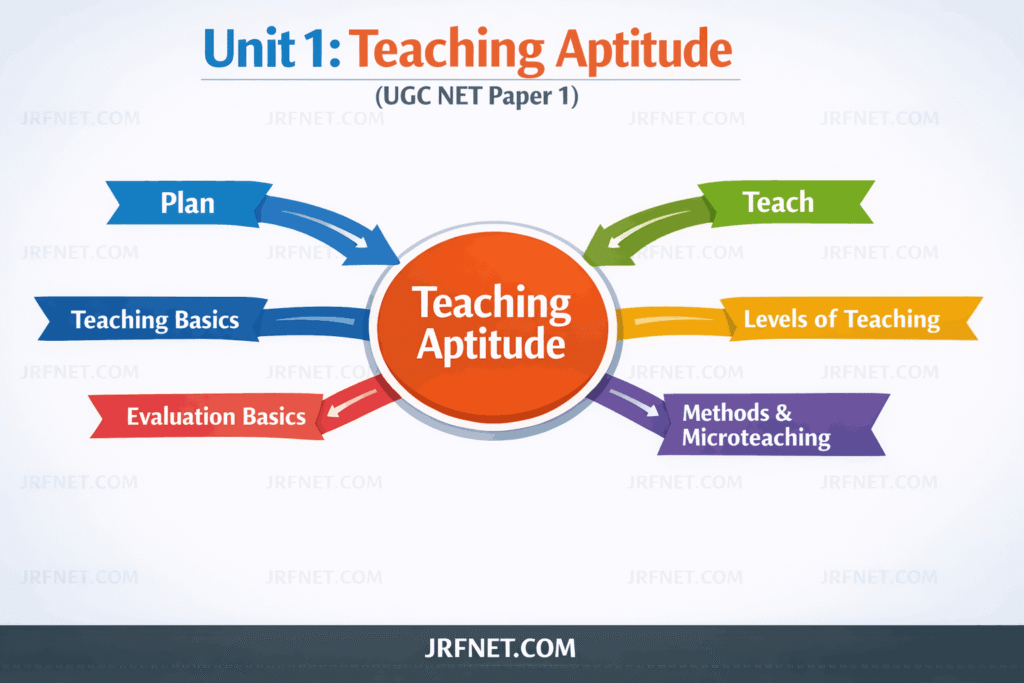
What is Teaching Aptitude
Teaching aptitude means your natural and learned ability to teach well. “Aptitude” means a person’s potential or capacity to do something successfully.
Meaning of Aptitude
Aptitude is the ability to learn a skill quickly and perform it better with practice. It is not exactly “talent” only; it is a mix of potential + training.
- Example: Two people attend the same teaching workshop, but one can apply the techniques faster. That person has higher teaching aptitude.
Meaning of Teaching Aptitude
Teaching aptitude is the ability to plan and conduct teaching effectively so that learners actually understand and improve.
It includes:
- Understanding learner needs
- Setting clear objectives (objectives means clear targets for learning)
- Choosing suitable methods
- Managing the classroom
- Using communication properly
- Checking learning through evaluation
- Improving teaching using feedback
Scope of Unit-1 in UGC NET Paper-1
This unit covers the complete teaching-learning basics, teacher-learner roles, classroom processes, and evaluation ideas.
What this unit covers
- Teaching concept, nature, objectives, and factors influencing teaching
- Learner characteristics and teacher characteristics
- Levels of teaching: Memory, Understanding, Reflective
- Learner-centred teaching and teacher-centred teaching
- Teaching methods, microteaching, and classroom management basics
- Evaluation and assessment-related fundamentals
- Use of ICT in teaching and support systems
What this unit does not cover
- Deep educational psychology theories (those come more in learning/psychology-focused parts)
- Research methodology (that is Unit 2)
- Detailed education policies and higher education bodies (Unit 10)
- Pure logical reasoning or DI calculations (Units 5, 6, 7)
Official Syllabus Topics of Unit-1
- Teaching: Concept, Objectives, Levels of teaching (Memory, Understanding and Reflective), Characteristics and basic requirements.
- Learner’s characteristics: Characteristics of adolescent and adult learners (Academic, Social, Emotional and Cognitive), Individual differences.
- Factors affecting teaching related to: Teacher, Learner, Support material, Instructional facilities, Learning environment and Institution.
- Methods of teaching in Institutions of higher learning: Teacher centered vs. Learner centered methods; Off-line vs. On-line methods (Swayam, Swayam Prabha, MOOCs etc.).
- Teaching Support System: Traditional, Modern and ICT based.
- Evaluation Systems: Elements and Types of evaluation, Evaluation in Choice Based Credit System in Higher education, Computer based testing, Innovations in evaluation systems.
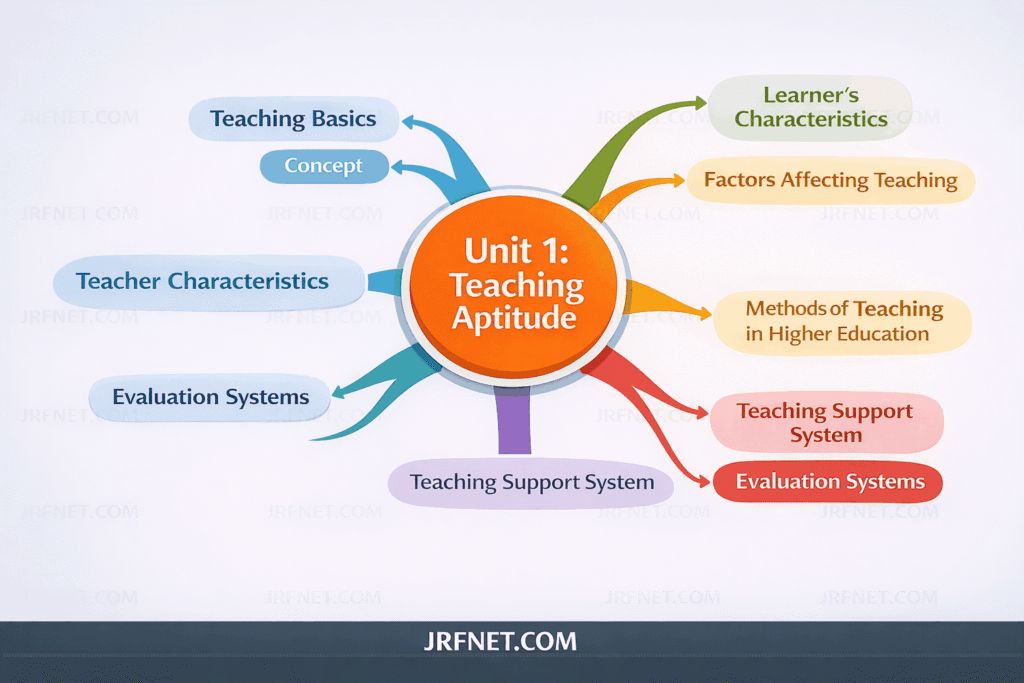
Below is the syllabus map written in an easy table so you can plan study topic-by-topic.
| Syllabus Topic | What it means in simple words | What they usually ask |
|---|---|---|
| Concept of Teaching | What teaching is and what makes it effective | Definition, features, role of teacher |
| Nature and Objectives | Teaching goals and its characteristics | Identify objectives, classroom outcomes |
| Learner’s Characteristics | Learner differences (age, ability, motivation) | Matching learner needs with methods |
| Factors Affecting Teaching | Environment, teacher, learner, content, resources | Scenario questions, barriers |
| Bloom’s Taxonomy | Cognitive, Affective, Psychomotor | Framework that helps teachers plan learning in steps |
| Teaching Levels | Memory, Understanding, Reflective | Compare levels, identify examples |
| Learner-centered Teaching | Focus on learner activity and participation | Constructivist-style questions |
| Micro teaching | Skill-based practice teaching in small steps | Steps, feedback, re-teach cycle |
| Classroom Management | Teaching Support Systems | Situations, best teacher action |
| Evaluation Basics | Measuring learning and improving teaching | Assessment vs evaluation, tools |
Weightage and PYQ Trend
Unit-1 usually contributes a steady share of questions because it is the base of teaching and classroom practice. Even when the question looks new, the concept behind it is often repeated.
Most repeated micro-topics
- Levels of teaching and their classroom examples
- Learner-centred teaching features
- Teaching vs training vs instruction vs education
- Microteaching cycle and key terms (skill, feedback, reinforcement)
- Evaluation vs assessment vs measurement
- Teacher qualities: professional, personal, and pedagogical
Common question styles
- Statement-based: identify correct statements
- Match the following: term with meaning
- Classroom scenario: what should teacher do
- Confusing pairs: differentiate between two terms
- Sequence/steps: microteaching, lesson planning stages
Key Terms You Must Know (Quick Glossary)
- Teaching: Helping learning happen in a planned way.
- Learning: A relatively permanent change in behaviour/knowledge due to experience.
- Training: Skill-focused practice for a specific job task.
- Instruction: Step-by-step guidance for learning a specific topic.
- Education: Overall development of a person (knowledge, values, skills).
- Pedagogy: The art and science of teaching (means how teaching is designed and delivered).
- Method: A general way of teaching (lecture, discussion).
- Strategy: A plan to achieve learning (like cooperative learning strategy).
- Technique: A small tool/skill used inside a method (questioning, probing).
- Approach: A belief-based direction (constructivist approach means students build knowledge by doing).
Unit-1 Blueprint (Concept Map)
Use this blueprint to study in a clean order. Only this section uses hierarchy numbering because it helps you revise faster.
- Teaching Basics
- Concept, nature, objectives
- Factors affecting teaching
- Teacher and Learner
- Teacher qualities and roles
- Learner characteristics and diversity
- Classroom Teaching Process
- Levels of teaching
- Teaching methods and learner-centred teaching
- Skill Development in Teaching
- Microteaching: skills, cycle, feedback
- Classroom Outcomes and Improvement
- Evaluation basics
- Assessment vs measurement vs evaluation
- Feedback and improvement loop
Most Confusing Areas and Common Traps
Many students lose marks because they know the meaning but mix similar words.
Teaching vs Training vs Instruction vs Education
- Teaching: Broad classroom process to help learning.
- Training: Practice to develop a specific skill.
- Instruction: Structured guidance, often content-focused.
- Education: Overall development with values and personality growth.
Exam Point of View: If the question focuses on “job skill” or “performance task”, it is usually training. If it focuses on “overall development”, it is education.
Assessment vs Measurement vs Evaluation
- Measurement: Giving numbers (marks, score, rating).
- Assessment: Collecting evidence of learning (tests, projects, observation).
- Evaluation: Judging value and making decisions (grading, promotion, improving teaching).
Exam Point of View: If the question includes “decision” (improve, certify, grade), it is evaluation. If it includes “number/score”, it is measurement.
How to Study Unit-1 (7–10 Day Plan)
This plan is realistic for revision + PYQs.
| Day | Topic Focus | Practice |
|---|---|---|
| Day 1 | Teaching | Added Practice Questions, Quick Revision notes at the end of the article. |
| Day 2 | Learner’s Characteristics | Added Practice Questions, Quick Revision notes at the end of the article. |
| Day 3 | Factors Affecting Teaching | Added Practice Questions, Quick Revision notes at the end of the article. |
| Day 4 | Methods of Teaching in Higher Education | Added Practice Questions, Quick Revision notes at the end of the article. |
| Day 5 | Teaching Support System | Added Practice Questions, Quick Revision notes at the end of the article. |
| Day 6 | Evaluation Systems | Added Practice Questions, Quick Revision notes at the end of the article. |
| Day 7 | Full Unit-1 Revision | Read Quick Revision Notes of every tutorial page |
| Day 8 | Do Practice on with all the Unit 1 Questions | Practice from here |
| Day 9 | Quick Revision Notes, Short Notes | Read Quick Revision Notes of every tutorial page, and also read Short Notes |
| Day 10 | Final Revision | Read Quick Revision Notes, Short Notes, Practice Some Questions |
Previous Year Question Styles from Unit-1
- Scenario: “A teacher asks students to discuss in groups…” identify method or approach.
- Match the following type: Levels of teaching with their features.
- Statement-correct: features of learner-centred teaching.
- Difference: evaluation vs assessment; teaching vs training.
- Sequence: steps of microteaching or lesson planning.
Key Points – Takeaways
- Teaching aptitude means the ability to plan and deliver teaching effectively.
- Aptitude is potential plus ability to improve with practice.
- Teaching is broader than instruction; education is broader than teaching.
- Learner characteristics include ability, motivation, background, learning style.
- Teacher characteristics include subject knowledge, communication, empathy, and planning.
- Levels of teaching are memory, understanding, and reflective.
- Learner-centred teaching focuses on active participation and construction of knowledge.
- Microteaching improves one teaching skill at a time using feedback and re-teach.
Exam Point of View: Most mistakes happen in confusing pairs. Always look at the “focus word” in the question (score/decision/skill/overall development).
- Classroom management includes discipline, motivation, engagement, and time use.
- Evaluation is decision-making based on evidence; assessment is evidence collection.
- Measurement gives numbers; evaluation gives judgement.
- PYQs often repeat same concepts with new examples.
Exam Point of View: If options are very close, identify which option contains the “core keyword” like decision, judgement, score, skill, values.
Mini Practice
1) A teacher divides students into groups, gives a real-life problem, and asks them to present solutions. Which style is MOST visible?
A) Pure lecture method
B) Learner-centred teaching
C) Rote memorization
D) Drill and practice only
Answer: B
Explanation: Students actively solve and present; learner activity is central, so it is learner-centred teaching.
2) Which pair is correctly matched?
A) Measurement – judgement
B) Evaluation – giving raw marks
C) Assessment – collecting evidence of learning
D) Education – only skill training
Answer: C
Explanation: Assessment is the process of collecting learning evidence through tests, tasks, observation, etc.
3) Assertion–Reason
Assertion (A): Evaluation is broader than measurement.
Reason (R): Evaluation includes judgement and decision-making using evidence.
A) Both A and R are true and R explains A
B) Both A and R are true but R does not explain A
C) A is true but R is false
D) A is false but R is true
Answer: A
Explanation: Measurement is only numbers, while evaluation includes judgement and decisions, so evaluation is broader.
4) Which level of teaching focuses on problem-solving, critical thinking, and originality?
A) Memory level
B) Understanding level
C) Reflective level
D) Drill level
Answer: C
Explanation: Reflective level is about thinking deeply, solving problems, and producing new ideas.
5) Microteaching mainly helps a teacher to:
A) Teach full syllabus in one class
B) Improve one teaching skill with feedback
C) Replace evaluation in schools
D) Avoid lesson planning
Answer: B
Explanation: Microteaching is skill-based practice with feedback and re-teach to improve one skill at a time.
FAQs
What is Teaching Aptitude in UGC NET Paper 1?
It is the ability to teach effectively using planning, communication, methods, and evaluation.
Is Unit-1 Teaching Aptitude scoring?
Yes, because concepts repeat and many questions are concept-based rather than calculation-heavy.
What are the most important topics in Unit-1?
Levels of teaching, learner-centred teaching, microteaching, and evaluation-related differences.
What is the easiest way to revise Unit-1?
Use the unit blueprint + glossary + PYQs and revise confusing pairs daily.
What is the common trap in Unit-1 questions?
Mixing similar terms like assessment vs evaluation and teaching vs training.
Do I need real classroom experience for Unit-1?
No, but understanding classroom situations helps solve scenario MCQs faster.