
Introduction
People, Development and Environment is the unit where Paper-1 connects “human life” with “nature” in a very practical way.
You study how development (growth of cities, industries, lifestyle) changes the environment, and how environmental problems affect people’s health and quality of life.
This unit is scoring because questions are often direct, based on basic concepts, examples, and global agreements.
It also includes important laws, action plans, and international efforts related to climate and environment.
In Real Life: When a city grows fast, traffic and factories increase, and the air becomes unhealthy, this unit explains that link.
Exam Point of View: Expect 4–6 easy-to-medium questions from goals, pollution, climate, laws, and agreements.
What is People, Development and Environment
People, Development and Environment means studying the relationship between humans and nature while societies grow.
“Development” here means progress like better roads, jobs, industries, and technology, but it can also create pollution and resource shortages.
This unit is important in Paper-1 because it tests your awareness of real-world issues like climate change, waste, disasters, and major environment agreements.
It also checks whether you can connect concepts to situations (example: floods after deforestation).
Scope of People, Development and Environment in UGC NET Paper-1
What this unit covers
- Development goals (MDGs and SDGs) and how they relate to the environment
- Human–environment interaction (how humans use and harm nature)
- Pollution and waste, and their effects on human health
- Natural and energy resources (solar, wind, forests, etc.)
- Disasters and mitigation (how to reduce disaster damage)
- Environment laws and international agreements (EPA 1986, Paris Agreement, etc.)
What this unit does not cover
- Deep engineering-level calculations (like climate modelling equations)
- Advanced chemical reactions of pollutants (beyond basic effects)
- Very detailed geography-only concepts (like full geomorphology)
- Subject-specific environmental science depth (beyond Paper-1 level)
Official Syllabus Topics of People, Development and Environment
- Development and environment: Millennium development and Sustainable development goals.
- Human and environment interaction: Anthropogenic activities and their impacts on environment.
- Environmental issues: Local, Regional and Global; Air pollution, Water pollution, Soil pollution, Noise pollution, Waste (solid, liquid, biomedical, hazardous, electronic), Climate change and its Socio-Economic and Political dimensions.
- Impacts of pollutants on human health.
- Natural and energy resources: Solar, Wind, Soil, Hydro, Geothermal,
- Biomass, Nuclear and Forests.
- Natural hazards and disasters: Mitigation strategies.
- Environmental Protection Act (1986), National Action Plan on Climate Change, International agreements/efforts -Montreal Protocol, Rio Summit, Convention on Biodiversity, Kyoto Protocol, Paris Agreement, International Solar Alliance.
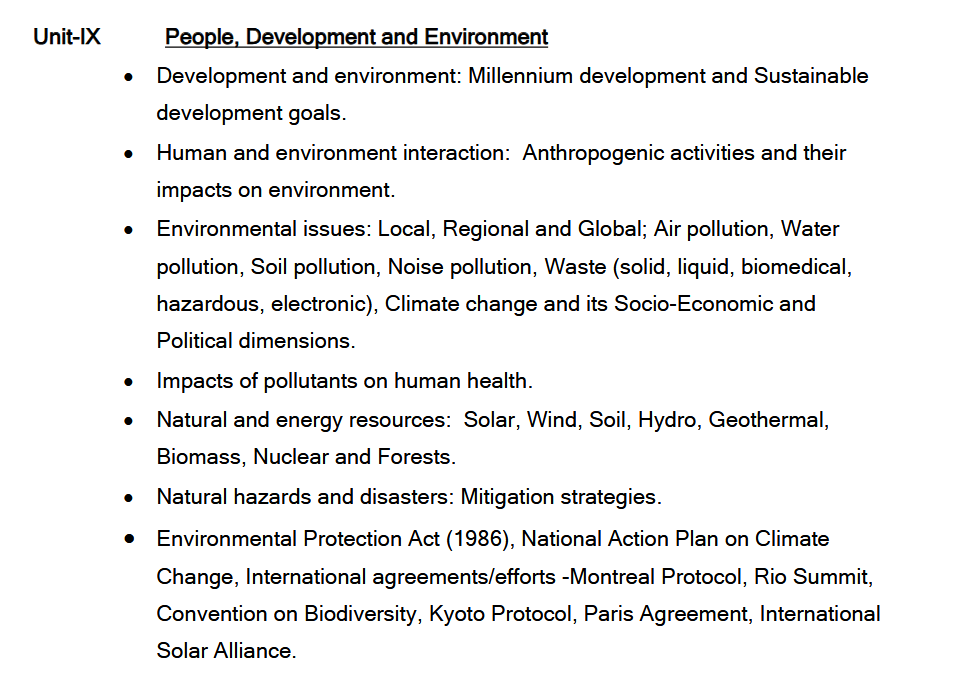
The following topics are taken from the official Paper-1 syllabus (Unit-IX).
| Official Syllabus Topic | Simple Explanation | What to Focus for MCQs |
|---|---|---|
| Development and environment: Millennium development and Sustainable development goals | Development should improve life, but must protect nature too. MDGs are older targets; SDGs are broader newer goals. | MDGs vs SDGs, goal themes, keywords like “sustainability” |
| Human and environment interaction: Anthropogenic activities and their impacts on environment | Anthropogenic means “human-made”. Activities like industries, farming, mining impact air, water, forests. | Deforestation, urbanization, industrial emissions, examples |
| Environmental issues: Local, Regional and Global; Air, Water, Soil, Noise; Waste; Climate change (socio-economic and political dimensions) | Environmental issues happen at different levels and affect society, money, and politics too. | Pollution types, waste categories, climate change impacts |
| Impacts of pollutants on human health | Pollutants cause diseases like asthma, skin issues, water-borne diseases, hearing loss, etc. | Pollutant → disease mapping, vulnerable groups |
| Natural and energy resources: Solar, Wind, Soil, Hydro, Geothermal, Biomass, Nuclear and Forests | Resources are inputs for human life and development. Some are renewable, some risky, some limited. | Renewable vs non-renewable, examples, advantages/limits |
| Natural hazards and disasters: Mitigation strategies | Hazards become disasters when people are exposed and unprepared. Mitigation reduces damage. | Mitigation examples, preparedness, early warning |
| Environmental Protection Act (1986), NAPCC, International agreements (Montreal, Rio, CBD, Kyoto, Paris, ISA) | India has laws and plans; the world has agreements to control pollution and climate change. | Act-year link, agreement purpose, match-the-following |
Weightage and PYQ Trend
Officially, Paper-1 follows a pattern where five questions are set from each unit (each of 2 marks).
So, Unit 9 commonly contributes 5 questions = 10 marks in many shifts.
Most repeated micro-topics
- MDGs vs SDGs (basic differences + examples)
- Climate change, global warming, greenhouse effect (conceptual traps)
- Types of pollution + examples (air/water/soil/noise)
- Waste types: biomedical vs hazardous vs e-waste (easy match questions)
- Disasters: mitigation and preparedness (scenario-friendly)
- Agreements and acts: Paris, Kyoto, Montreal, CBD, Rio Summit, EPA 1986, NAPCC
Common question styles (match, statement-based, scenario, assertion–reason)
- Match the following: Agreement → purpose / Waste type → example
- Statement-based: “Which statements are correct about SDGs / pollution?”
- Scenario-based: “A city facing smog… identify pollutant type / solution”
- Assertion–Reason: Climate claim + reason about greenhouse gases
- One-liner factual: Year, act name, agreement name, full form (NAPCC)
Unit Blueprint (Concept Map in Text Format)
- Development and Environment
1.1) Meaning of development (growth + welfare)
1.2) MDGs and SDGs (targets, themes)
1.3) Sustainable development (balance people + planet) - Human–Environment Interaction
2.1) Anthropogenic activities (human-made actions)
2.2) Impacts (deforestation, pollution, resource depletion)
2.3) Quality of life link (health, livelihood, migration) - Environmental Issues
3.1) Levels: Local / Regional / Global
3.2) Pollution: Air / Water / Soil / Noise
3.3) Waste: Solid / Liquid / Biomedical / Hazardous / E-waste
3.4) Climate change: socio-economic + political dimensions - Health Impacts
4.1) Pollutants and diseases (respiratory, water-borne, hearing, cancers)
4.2) Vulnerable groups (children, elderly, workers) - Resources and Disasters
5.1) Natural & energy resources (solar, wind, hydro, forests, nuclear)
5.2) Hazards vs disasters
5.3) Mitigation strategies (preparedness, planning, early warning) - Laws and International Efforts
6.1) Environmental Protection Act 1986
6.2) NAPCC (India’s climate plan)
6.3) International agreements (Montreal, Kyoto, Paris, CBD, ISA)
Most Confusing Areas and Common Traps
1) MDGs vs SDGs
MDGs (Millennium Development Goals) were time-bound global goals mainly focused on basic human development.
SDGs (Sustainable Development Goals) are broader goals that combine people, economy, and environment together.
Exam Point of View: Many options look correct, spot the “broader + sustainability + 17 goals” clue for SDGs.
2) Global Warming vs Climate Change
Global warming is the increase in Earth’s average temperature.
Climate change is wider—it includes temperature rise plus changes in rainfall, storms, sea level, and seasons.
Situational Example: If a place faces hotter summers plus irregular monsoons, that is climate change, not only global warming.
3) Mitigation vs Adaptation
Mitigation means reducing the cause (example: reducing emissions, planting forests).
Adaptation means adjusting to effects (example: flood-resistant houses, drought-resistant crops).
Exam Point of View: If the action reduces greenhouse gases, it is mitigation. If it reduces damage, it is adaptation.
How to Study People, Development and Environment (8 Days Plan)
Previous Year Question Styles from People, Development and Environment
- Match the following (Agreement / Act / Waste)
Example: Match “Montreal Protocol” with “ozone-depleting substances control”. - Statement-based (choose correct statements)
Example: “SDGs include environmental targets” (True/False style in options). - Scenario-based (real-life situation)
Example: “A river near industries has dead fish—identify pollution type and likely cause.” - Assertion–Reason
Example: “Assertion: Climate change impacts agriculture. Reason: Rainfall patterns are changing.” - “Odd one out” (resources / waste / pollution)
Example: “Which is NOT a renewable resource: solar, wind, hydro, coal?” - Year / Fact-based (quick recall)
Example: “Environmental Protection Act is of which year?”
Key Points – Takeaways
- Unit 9 links human development with environmental balance and quality of life.
- Anthropogenic activities means human-made actions that change nature.
- SDGs are wider and more environment-focused than MDGs.
- Pollution questions are mostly example-based and easy scoring.
Exam Point of View: In MCQs, they test “keyword spotting” like mitigation/adaptation, SDG/MDG, and waste categories.
- Waste types are commonly mixed up: biomedical, hazardous, and e-waste.
- Climate change includes social, economic, and political impacts, not only science.
- Health impacts are asked as pollutant → disease mapping.
- Disasters are often asked through scenario and mitigation measures.
Exam Point of View: If options look similar, identify whether the action reduces cause (mitigation) or reduces impact (adaptation).
- Renewable resources are naturally replenished (solar, wind, hydro, biomass).
- Nuclear is an energy source but has safety and waste concerns.
- International agreements are asked in match-the-following format.
- EPA 1986 and NAPCC are key India-focused areas.
Exam Point of View: Don’t memorize blindly—remember “agreement → main purpose” as a one-line hook.
- Local vs regional vs global issues can be separated using examples (smog in a city vs acid rain vs climate change).
- Most questions stay within basic awareness + application to real situations.
Mini Practice (5 MCQs)
1) Scenario-based MCQ
A city has frequent coughing cases, low visibility, and heavy traffic jams daily. Which environmental issue is most directly indicated?
A) Water pollution
B) Air pollution
C) Soil pollution
D) Noise pollution
Answer: B) Air pollution
Explanation: Smog/low visibility and respiratory problems strongly point to polluted air, often from vehicles and emissions.
2) Comparison/Difference MCQ
Which option correctly differentiates mitigation from adaptation?
A) Mitigation adjusts lifestyle; adaptation reduces emissions
B) Mitigation reduces causes; adaptation reduces damage from effects
C) Mitigation is only for floods; adaptation is only for droughts
D) Mitigation and adaptation mean the same
Answer: B) Mitigation reduces causes; adaptation reduces damage from effects
Explanation: Mitigation targets root causes (like emissions). Adaptation helps people cope (like flood-resistant planning).
3) Statement-based MCQ
Choose the most correct statement:
A) SDGs are narrower than MDGs
B) SDGs mainly ignore environmental targets
C) SDGs include social, economic, and environmental targets together
D) SDGs are only for developed countries
Answer: C) SDGs include social, economic, and environmental targets together
Explanation: SDGs are broader and integrate “people + planet + prosperity” type targets.
4) Assertion–Reason MCQ
Assertion (A): Climate change can increase migration from rural areas.
Reason (R): Irregular rainfall and drought can reduce farming income and water availability.
A) Both A and R are true, and R is the correct explanation of A
B) Both A and R are true, but R is not the correct explanation of A
C) A is true, but R is false
D) A is false, but R is true
Answer: A) Both A and R are true, and R is the correct explanation of A
Explanation: Reduced income and water stress push people to move for jobs and safety, so R explains A.
5) Quick Recall + Concept MCQ
Which of the following is biomedical waste?
A) Old computer keyboard
B) Used syringe from a clinic
C) Plastic bottle from home
D) Sand from construction site
Answer: B) Used syringe from a clinic
Explanation: Biomedical waste comes from medical activities (sharps, bandages, lab waste), and needs safe disposal.
FAQs
What is the main focus of Unit 9 in UGC NET Paper 1?
It focuses on how development impacts the environment and how environmental issues affect human life and health.
How many questions usually come from People, Development and Environment?
Often around 5 questions, but it can vary slightly across shifts.
Is MDG vs SDG important for the exam?
Yes, it is a very common comparison area and appears in statement and match questions.
Are international agreements asked in UGC NET Paper 1?
Yes, mainly in match-the-following and factual recall formats.
What is the easiest scoring part of this unit?
Pollution types, waste categories, and basic mitigation measures are usually straightforward and scoring.
Do I need to study deep environmental science for this unit?
No, focus on basic concepts, examples, laws, agreements, and application-based MCQs.