
Table of Contents
Introduction
NEP 2020 means National Education Policy 2020, a national-level policy document that guides how India should improve education from early childhood to higher education. It replaces the older National Policy on Education 1986 and focuses on learning that builds understanding, skills, values, and communication abilities, not only marks.
NEP 2020 also connects education with real-life needs like jobs, research, technology use, and lifelong learning. It supports flexibility in choosing subjects, learning at different speeds, and earning credits that can be saved and used later.
In Real Life: NEP 2020 influences school structure, language learning, assessment patterns, degree design, credit systems, and how institutions are regulated.
Exam Point of View: UGC NET Paper 1 commonly asks 5+3+3+4 stages, GER targets, ABC, multiple entry-exit, HECI verticals, PARAKH, NRF, and NETF.
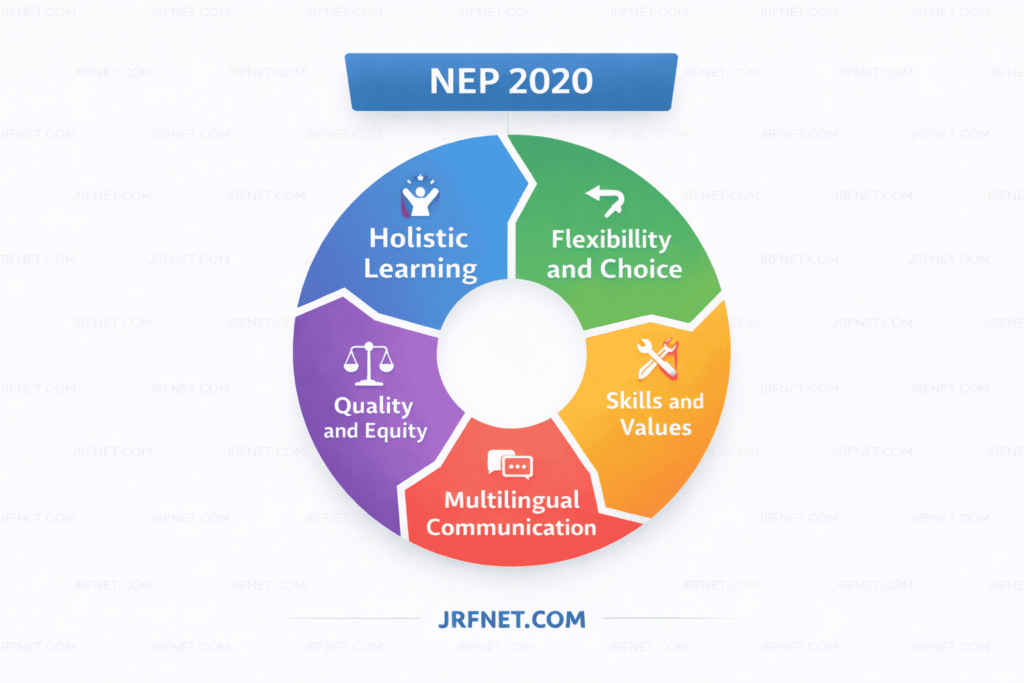
1. NEP 2020 Overview and Philosophy
1.1 What NEP 2020 tries to achieve
NEP 2020 aims to build an education system that develops knowledge, skills, values, and character together. When NEP says holistic, it means “overall development of the learner”, including communication, creativity, ethics, and problem-solving, not just textbook memory.
It also tries to make education:
- More accessible so more learners can enter and continue.
- More equitable so disadvantaged learners get real support.
- More quality-driven so outcomes improve, not only enrolments.
- More flexible so learners can choose paths and return later.
1.2 Core guiding principles in NEP 2020
NEP 2020 repeatedly highlights these principles and they are MCQ-friendly.
- Learner-centric approach where teaching matches learner needs and pace.
- Conceptual understanding over rote memorization.
- No hard separations between arts and science, curricular and co-curricular, vocational and academic.
- Multidisciplinary learning where subjects connect naturally.
- Ethics and constitutional values to build responsible citizens.
- Use of technology for access, quality, and governance.
- Respect for Indian languages and multilingual education.
1.3 Key terms you must understand
- Policy: A guiding plan, not a daily timetable.
- GER: Gross Enrolment Ratio, total enrolment compared to the official age group population.
- Multidisciplinary: Learning multiple fields together, like economics with data science.
- Vocational education: Job-skill learning like carpentry, coding basics, electrical work.
- Credit: A unit that represents learning workload, used to complete degrees.
2. School Education Reforms in NEP 2020
2.1 The 5+3+3+4 school structure
NEP 2020 replaces the older 10+2 structure with 5+3+3+4, based on the child’s age and learning needs.
| Stage | Classes | Age group | Main focus |
|---|---|---|---|
| Foundational | 3 years preschool + Class 1–2 | 3–8 | Play-based learning, language, habits |
| Preparatory | Class 3–5 | 8–11 | Reading, writing, numbers, discovery learning |
| Middle | Class 6–8 | 11–14 | Subjects with experiments, critical thinking |
| Secondary | Class 9–12 | 14–18 | Flexibility, depth, multidisciplinary options |
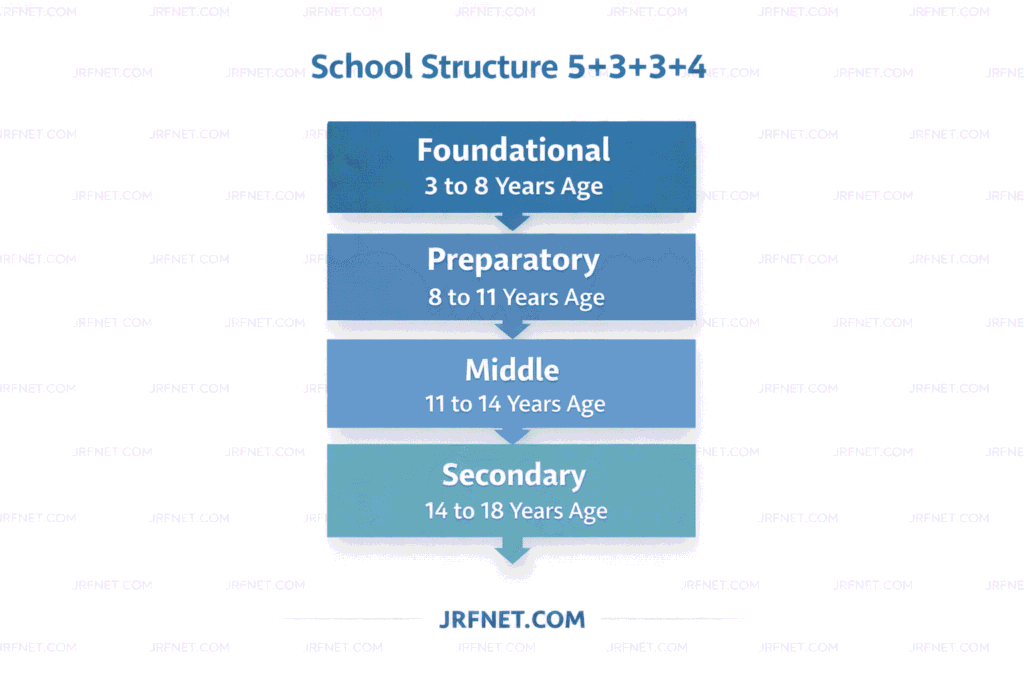
Exam Point of View: Many questions test the age mapping of stages, so remember the age bands along with 5+3+3+4.
2.2 ECCE as the foundation of communication and thinking
ECCE means Early Childhood Care and Education. NEP treats ages 3–6 as the strongest base because children form language, listening, and social skills in these years.
Key ECCE ideas in NEP 2020 include:
- Play-based and activity-based learning.
- Stories, songs, puzzles, role-play, and conversation.
- Better training and support for early childhood educators.
2.3 Foundational Literacy and Numeracy
Foundational Literacy and Numeracy means basic reading, writing, and maths ability that every child must get early. NEP calls it urgent because without FLN, students struggle in every subject later.
2.4 Curriculum and pedagogy changes
Pedagogy means “the method of teaching”, or simply “how teaching is done.” NEP 2020 pushes teaching that builds understanding and expression.
NEP promotes:
- Experiential learning through activities and projects.
- Discussion, debate, presentations, and group work.
- Reduced content load so students get time to think and communicate.
- Integration of arts, sports, and vocational exposure in learning.
2.5 Language policy and multilingual education
NEP supports teaching in the child’s home language because early learning becomes easier and clearer.
Key points you must remember:
- Home language or mother tongue should be the medium of instruction at least till Grade 5, and preferably till Grade 8 where possible.
- Three-language formula continues with flexibility.
- No language should be imposed on any State.
- Stronger focus on Indian languages and quality bilingual materials.
2.6 Assessment reforms and PARAKH
NEP wants assessment to check real learning, not only memory. It supports competency-based assessment and continuous feedback.
PARAKH stands for Performance Assessment, Review, and Analysis of Knowledge for Holistic Development, and it is set up as the National Assessment Centre at NCERT.
PARAKH supports:
- Improving assessment standards.
- Sharing best practices in testing.
- Helping move towards learning-based evaluation.
2.7 Vocational education from Class 6
NEP promotes vocational exposure from Class 6 onwards with hands-on work.
Key points include:
- Skill exposure and internships.
- Respect for skilled work.
- Removing the mindset that vocational equals “low status”.
2.8 Adult education and lifelong learning
NEP includes adult education so adults can continue learning throughout life.
It focuses on:
- Literacy and numeracy for adults.
- Digital literacy and basic life skills.
- Community support and flexible learning opportunities.
3. Higher Education Reforms in NEP 2020
3.1 Multidisciplinary higher education and flexibility
NEP wants colleges and universities to move towards multidisciplinary education.
A multidisciplinary system supports:
- Combining subjects across streams.
- Building broader thinking and better communication.
- Preparing learners for changing careers.
3.2 Multiple entry and exit in UG degrees
NEP introduces flexible entry and exit with formal recognition.
Commonly tested structure includes:
- Exit after 1 year with a Certificate.
- Exit after 2 years with a Diploma.
- Exit after 3 years with a Bachelor’s degree.
- Complete 4 years for a multidisciplinary Bachelor’s degree, often with research focus.
| Time spent | Exit award | What it means |
|---|---|---|
| 1 year | Certificate | Basic higher education foundation |
| 2 years | Diploma | More depth and employable skills |
| 3 years | Bachelor’s | Standard UG completion |
| 4 years | Bachelor’s with research focus | Stronger academic depth and research readiness |
Situational Example: A student exits after 2 years due to financial pressure, works for a year, and returns later to complete the remaining credits and finish the degree.
3.3 Academic Bank of Credits
The Academic Bank of Credits is a system to store and transfer credits earned by learners. It supports mobility, flexibility, and re-entry into education.
This supports:
- Learning from different approved institutions.
- Saving credits safely.
- Completing a degree with flexible pathways.
3.4 Postgraduate and research pathway changes
NEP suggests restructuring postgraduate education and strengthening research.
A high-scoring point is:
- M.Phil. is to be discontinued.
NEP also supports stronger research culture and research-oriented learning pathways.
3.5 National Research Foundation
The National Research Foundation is proposed to strengthen research culture and research funding across disciplines.
NRF supports:
- Research funding based on quality.
- Mentoring and research capacity building.
- Linking research with national and societal needs.
4. Governance, Regulation, and Quality Assurance in Higher Education
4.1 The idea of one umbrella regulator
NEP proposes HECI as an umbrella for higher education regulation, with a separation of functions so regulation, accreditation, funding, and academic standards do not mix confusingly.
4.2 Four verticals of HECI and their functions
NEP proposes four verticals and this is one of the most repeated MCQ areas.
| Vertical | Full name | Main function |
|---|---|---|
| NHERC | National Higher Education Regulatory Council | Regulation and basic norms |
| NAC | National Accreditation Council | Accreditation and quality rating |
| HEGC | Higher Education Grants Council | Funding and grants |
| GEC | General Education Council | Academic standards and learning outcomes |
Exam Point of View: If you forget the order, remember the logic as Regulation, Accreditation, Grants, Standards.
4.3 Accreditation and quality culture
NEP treats accreditation as a continuous quality improvement process.
It supports:
- Transparent quality indicators.
- Stronger institutional responsibility.
- A culture of self-improvement, not only inspection fear.
4.4 Institutional autonomy and good governance
NEP pushes autonomy with accountability, meaning institutions get more freedom but must show performance and transparency through quality standards and outcomes.
5. Technology, Digital Learning, and Communication Link
5.1 NETF and technology guidance
NEP proposes NETF to guide educational technology decisions with evidence and best practices.
NETF supports:
- Sharing successful digital teaching methods.
- Encouraging research-based edtech adoption.
- Promoting quality digital content, including Indian languages.
5.2 Digital communication skills as learning outcomes
NEP indirectly strengthens communication by encouraging:
- Presentations and project reports.
- Group discussion and teamwork.
- Digital tools for learning and expression.
- Critical thinking and writing practice.
5.3 Blended learning as a practical approach
Blended learning means a mix of face-to-face teaching and online support. NEP supports technology where it improves access and quality, while also caring about the digital divide, meaning unequal access to devices and internet.
6. Equity, Inclusion, and Teacher Education
6.1 Equity and inclusion focus
NEP stresses that access alone is not enough, so the system must support disadvantaged learners through targeted support mechanisms and inclusive strategies.
6.2 Teacher education reforms
Teacher quality is treated as the backbone of quality education.
A commonly asked point is:
- NEP supports a 4-year integrated B.Ed as the preferred teacher education pathway for future teachers.
NEP also emphasizes:
- Continuous professional development.
- Better recruitment and performance-based growth.
- Stronger teacher training institutions.
7. Targets, Timelines, and Funding
7.1 GER targets and timelines
These targets are directly used in statement-based questions.
- NEP aims 100% GER in school education from preschool to secondary level by 2030.
- NEP aims 50% GER in higher education by 2035.
7.2 Education spending vision
NEP supports increasing public investment in education towards 6% of GDP.
8. How UGC NET Paper 1 Asks NEP 2020
8.1 Most common question styles
- Match the verticals of HECI with functions.
- Identify correct stage mapping of 5+3+3+4.
- Choose correct statements about GER targets and timelines.
- Identify which body is linked with assessment, research, or technology.
8.2 Most common confusions and traps
- Confusing school GER 2030 with higher education GER 2035.
- Mixing NAC with NHERC.
- Mixing PARAKH with NETF.
- Forgetting that M.Phil. is proposed to be discontinued.
Key Points – Takeaways
- NEP 2020 is India’s current education policy and replaces the 1986 policy.
- School structure changes to 5+3+3+4 with clear age-stage mapping.
- ECCE is treated as the foundation stage for early learning and communication growth.
- NEP pushes conceptual learning, reduced rote learning, and no hard separations between streams.
Exam Point of View: If an MCQ asks which reform replaces 10+2, the safest answer is 5+3+3+4, not only “new curriculum.”
- Home language or mother tongue is recommended at least till Grade 5, preferably till Grade 8 where possible.
- PARAKH is the National Assessment Centre linked with assessment reforms.
- Higher education becomes flexible and multidisciplinary with multiple entry and exit.
- ABC supports storing and transferring credits for flexible learning paths.
Exam Point of View: In match questions, NAC is accreditation and NHERC is regulation, so do not swap them even if options look similar.
- HECI is proposed with four verticals, NHERC, NAC, HEGC, and GEC.
- NRF is proposed to strengthen research culture and research funding.
- NETF is proposed to guide educational technology adoption and sharing of best practices.
- NEP targets 100% school GER by 2030 and 50% higher education GER by 2035.
Exam Point of View: The fastest scoring approach is to memorize bodies with their purpose, PARAKH for assessment, NRF for research, NETF for technology, and NAC for accreditation.
Important Structures and Summary Tables in NEP 2020
1) One-view summary of key bodies
| Body | Linked area | What to remember |
|---|---|---|
| PARAKH | Assessment | National assessment support system |
| NETF | Technology | Guidance and best practices for edtech |
| NRF | Research | Strengthening research culture and funding |
| HECI | Higher education regulation | Umbrella with four verticals |
2) One-view summary of targets
| Target area | Target value | Timeline |
|---|---|---|
| School education GER | 100% from preschool to secondary | 2030 |
| Higher education GER | 50% including vocational education | 2035 |
Examples
Example 1: In a classroom, a teacher uses group discussion and short presentations after a chapter. Students learn to listen carefully, speak clearly, and build confidence, which matches NEP’s focus on communication and conceptual learning.
Example 2: A school conducts activity-based learning in the foundational stage using stories, role-play, and picture talk. Children improve vocabulary and expression naturally, which supports NEP’s ECCE and early language learning focus.
Example 3: A college student completes two years, exits due to a personal need, and later returns by using stored credits under the credit system. This reflects NEP’s multiple entry-exit and Academic Bank of Credits idea.
Example 4: Meena studied in her home language in early classes and understood concepts faster because the language felt natural. Later she learned additional languages and improved her ability to communicate with different people. In college she chose a mix of subjects and presented projects confidently. Over time, her learning became flexible, skill-based, and connected with real life, which is exactly the direction NEP 2020 promotes.
Quick One-shot Revision Notes
- NEP 2020 is the National Education Policy approved in 2020 and it replaces the earlier 1986 policy.
- School structure becomes 5+3+3+4 based on age and learning needs.
- Foundational stage covers ages 3 to 8 and includes preschool plus Classes 1 and 2.
- NEP supports strong ECCE as the base of language and learning habits.
- NEP stresses foundational literacy and numeracy as urgent learning goals.
- Home language or mother tongue is recommended at least till Grade 5, preferably till Grade 8 where possible.
- PARAKH is linked with assessment standards and improvement at the national level.
- Higher education becomes multidisciplinary with flexible pathways.
- Multiple entry and exit allows certificate, diploma, degree, and four-year degree pathways.
- ABC supports storing and transferring credits for flexible completion.
- HECI is proposed with NHERC, NAC, HEGC, and GEC as separate verticals.
- NRF is proposed to strengthen research culture.
- NETF is proposed to guide educational technology decisions.
- School education GER target is 100% by 2030 and higher education GER target is 50% by 2035.
- NEP supports moving public investment in education towards 6% of GDP.
Mini Practice
Q1) A student leaves a UG program after 2 years due to a job and later returns to complete the remaining credits using a digital credit record. Which NEP 2020 idea fits best
A) PARAKH
B) ABC and multiple entry-exit
C) NAC
D) NETF
Answer: B
Explanation: Multiple entry-exit allows leaving and returning, and ABC stores credits for later use.
Q2) Which option correctly shows the difference between NAC and NHERC
A) NAC regulates, NHERC accredits
B) NAC accredits, NHERC regulates
C) NAC funds, NHERC sets standards
D) NAC sets standards, NHERC funds
Answer: B
Explanation: NAC is for accreditation and NHERC is the regulator vertical under the HECI idea.
Q3) Consider the statements and choose the correct option
Statement 1 is NEP aims 100% GER from preschool to secondary level by 2030
Statement 2 is NEP aims 50% GER in higher education by 2035
A) Only Statement 1 is correct
B) Only Statement 2 is correct
C) Both statements are correct
D) Both statements are incorrect
Answer: C
Explanation: Both targets are explicitly stated as key enrolment goals with different timelines.
Q4) Assertion (A): NEP 2020 recommends home language or mother tongue as the medium of instruction at least till Grade 5 where possible
Reason (R): Children understand concepts faster and express better when early learning happens in a familiar language
A) Both A and R are true and R explains A
B) Both A and R are true but R does not explain A
C) A is true but R is false
D) A is false but R is true
Answer: A
Explanation: NEP supports early learning in home language because it improves comprehension and expression in early years.
Q5) Match the body with the correct area and choose the correct option
Body 1 is PARAKH
Body 2 is NRF
Body 3 is NETF
A) Assessment, Technology, Research
B) Research, Assessment, Technology
C) Assessment, Research, Technology
D) Technology, Research, Assessment
Answer: C
Explanation: PARAKH links to assessment, NRF links to research culture, and NETF links to educational technology guidance.
FAQs
What is NEP 2020 in simple words
NEP 2020 is India’s education policy that reforms school and higher education with flexibility, skills, and quality.
What does 5+3+3+4 mean in NEP 2020
It is the new school structure based on learning stages and age groups instead of the old 10+2 system.
What is ABC in NEP 2020
ABC is Academic Bank of Credits that stores a learner’s earned credits for transfer and flexible degree completion.
What is PARAKH in NEP 2020
PARAKH is the National Assessment Centre linked with improving assessment quality and learning-based evaluation.
What are the four verticals of HECI
NHERC for regulation, NAC for accreditation, HEGC for funding, and GEC for academic standards.
What is NETF in NEP 2020
NETF is a proposed forum that supports evidence-based guidance and sharing of best practices in educational technology.