
Indian Logic in UGC NET Paper 1 Unit 6 is about how Indian philosophers tested knowledge and reasoning, mainly through Pramāṇa which means valid sources of knowledge.
This unit feels “philosophy-like”, but questions are usually direct, concept-based, and very score-friendly once your basics are clear.
You mainly study the idea of means of knowledge, the six pramāṇas, and inference parts like vyāpti and fallacies.
In Real Life: When you say “I know it because I saw it” or “I know it because someone reliable told me”, you are using pramāṇa thinking.
Exam Point of View: Most questions test quick identification like “Which pramāṇa is this” or “Which hetvābhāsa is this”.
What is Indian Logic
Indian Logic is the Indian way of checking whether knowledge is valid and how conclusions are reached correctly. In simple words, it teaches “How do you know that you know”.
In Paper 1, Indian Logic matters because it builds your accuracy in inference-based questions and helps you avoid trap options that look correct but are logically weak.
Also, the official syllabus directly includes Indian Logic and pramāṇas inside Unit 6, so you cannot skip it.
Scope of Indian Logic in UGC NET Paper-1
What this unit covers
- Indian Logic as means of knowledge which means sources that produce valid knowledge.
- Pramāṇas which are six main ways to know something like perception, inference, comparison, testimony, implication, and non-apprehension.
- Inference-focused ideas like structure of anumāna, kinds of anumāna, vyāpti which means invariable relation, and hetvābhāsa which means fallacies of inference.
What this unit does not cover
- Western logic parts like Venn diagrams, categorical propositions, square of opposition, and formal fallacies are in Unit 6 overall, but they are not part of “Indian Logic only” coverage on this landing page.
- Blood relation, coding-decoding, and other aptitude-style reasoning are not Indian Logic topics.
Official Syllabus Topics of Indian Logic
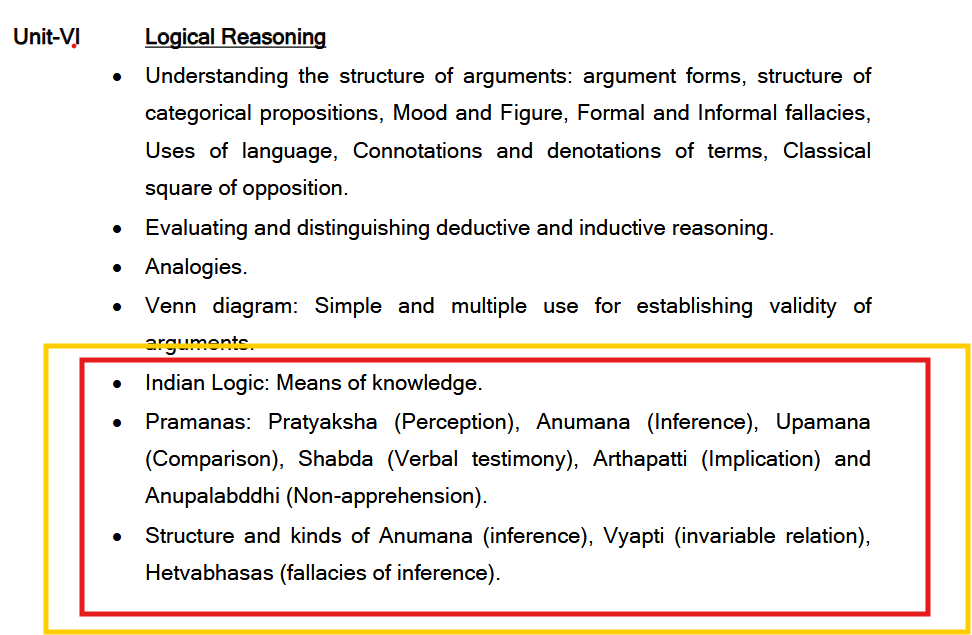
The following topics are taken from the official UGC Paper 1 syllabus under Unit 6 Logical Reasoning, focusing only on the Indian Logic part.
| Official syllabus topic | What you should learn |
|---|---|
| Indian Logic means of knowledge | Understand what “means of knowledge” is and why Indian Logic treats knowledge as valid only when it comes from a proper source. |
| Pramāṇas: Pratyaksha, Anumana, Upamana, Shabda, Arthapatti, Anupalabdhi | Learn the meaning of each pramāṇa and how to identify it from a short example situation. |
| Structure and kinds of Anumāna, Vyāpti, Hetvābhāsas | Learn how inference works, what makes a reason valid, what vyāpti means, and how wrong reasons become fallacies. |
Weightage and PYQ Trend
Officially, Paper 1 sets five questions from each unit, and each question carries 2 marks, so Unit 6 contributes 10 marks in total.
Indian Logic is a sub-part of Unit 6, so the number of Indian Logic questions can vary shift to shift, but it appears regularly in PYQs.
Most repeated micro-topics
- Pramāṇa identification through examples, especially Pratyaksha vs Anumana
- Anumāna basics like paksha, sadhya, hetu as idea-level terms
- Vyāpti meaning and its role in inference
- Hetvābhāsa types and quick spotting, especially confusing ones like savyabhichāra and viruddha
- Arthāpatti vs Anumāna confusion type questions
- Anupalabdhi meaning and when “absence” counts as knowledge
Common question styles (match, statement-based, scenario, assertion–reason)
- Match pramāṇa with definition or example
- Statement-based questions on which pramāṇa fits
- Scenario questions where a small story is given and you choose the pramāṇa
- Assertion–reason questions on vyāpti, inference validity, and hetvābhāsa spotting
Unit Blueprint
- Core Idea
1.1) Knowledge as valid knowledge
1.2) Means of knowledge - Six Pramāṇas
2.1) Pratyaksha
2.2) Anumana
2.3) Upamana
2.4) Shabda
2.5) Arthapatti
2.6) Anupalabdhi - Anumāna Deep Focus
3.1) Structure of inference
3.2) Kinds of inference
3.3) Vyāpti relation - Error Checking
4.1) What makes a reason weak
4.2) Hetvābhāsa fallacies - Common Confusions
5.1) Pratyaksha vs Anumana
5.2) Upamana vs Shabda
5.3) Arthapatti vs Anumana
5.4) Vyāpti vs Hetu
Most Confusing Areas and Common Traps
Confusing pair 1: Pratyaksha vs Anumana
Pratyaksha means knowledge by direct perception, like seeing smoke.
Anumana means knowledge by inference, like concluding fire because of smoke.
Exam Point of View: If the question includes “because of a sign” and not direct sensing, it usually points to Anumana.
Confusing pair 2: Shabda vs Upamana
Shabda means knowledge from reliable verbal testimony, like learning a fact from a trusted teacher or text.
Upamana means knowledge by comparison, like identifying something by similarity after being told “it looks like that”.
Situational Example: You are told “a gavaya looks like a cow”. Later in a forest you see a similar animal and identify it as gavaya. This is Upamana.
Confusing pair 3: Arthapatti vs Anumana
Arthapatti is implication or postulation, meaning you assume a missing fact to make two facts fit together.
Anumana is inference from a sign and a rule-like relation.
Exam Point of View: If the question says “Both statements must be true, so what must be assumed”, it often signals Arthapatti.
How to Study Indian Logic (6 Days Plan)
Previous Year Question Styles from Indian Logic
- Definition pick
Example: Choose the correct meaning of Anupalabdhi. - Pramāṇa identification from a mini story
Example: A person concludes “there is fire” after seeing smoke. - Match the following
Example: Match Pratyaksha, Shabda, Upamana with correct descriptions. - Confusing pair choice
Example: Distinguish Arthapatti from Anumana using the best option. - Assertion–reason logic
Example: Test whether vyāpti is necessary for valid inference. - Fallacy spotting
Example: Identify which hetvābhāsa is present in a given wrong reason.
Key Points – Takeaways
- Pramāṇa means a valid source of knowledge, not just any belief.
- Indian Logic in Paper 1 mainly tests means of knowledge and inference parts.
- Pratyaksha is direct perception, so it needs “direct contact” with the object idea.
- Anumana is inference, so it needs a sign and a dependable relation idea.
- Upamana works through similarity and comparison-based identification.
- Shabda depends on reliable testimony, so source trust matters.
Exam Point of View: Options often mix Upamana and Shabda, so look for “similarity” words to lock Upamana.
- Arthapatti is used when you must assume a hidden fact to keep facts consistent.
- Anupalabdhi is knowing absence, so the mind treats “not found where expected” as knowledge.
- Vyāpti is the invariable relation behind inference, like “wherever smoke, there is fire”.
- Hetvābhāsa is a wrong reason that looks like a reason, causing a faulty inference.
Exam Point of View: Many questions are “spot the flaw”, so learn 1 keyword clue for each common hetvābhāsa.
- Most questions are short, so speed comes from fast recognition, not long writing.
- Revise pramāṇas with one example each, daily, for strong retention.
Exam Point of View: If you can solve quickly, you save time for tougher units like DI and ICT.
Mini Practice (5 MCQs)
- A student sees dark clouds and concludes that it will rain soon. This best matches which pramāṇa
A) Pratyaksha
B) Anumana
C) Upamana
D) Anupalabdhi
Answer: B
Explanation: The student is not directly perceiving rain, but inferring it from a sign. - Which option best shows the difference between Shabda and Upamana
A) Shabda is perception, Upamana is inference
B) Shabda is testimony, Upamana is comparison
C) Shabda is implication, Upamana is absence
D) Shabda is comparison, Upamana is testimony
Answer: B
Explanation: Shabda depends on reliable words, while Upamana depends on similarity and comparison. - Read the statements and choose the correct option
Assertion (A): Vyāpti is necessary for a valid inference in Anumana.
Reason (R): Vyāpti means an invariable relation between hetu and sadhya.
A) Both A and R are true and R is the correct explanation of A
B) Both A and R are true but R is not the correct explanation of A
C) A is true but R is false
D) A is false but R is true
Answer: A
Explanation: Inference needs a dependable rule-like link, and vyāpti is exactly that link. - A person knows “the jar is not on the table” after looking carefully at the table and finding it absent. This best matches
A) Arthapatti
B) Shabda
C) Anupalabdhi
D) Upamana
Answer: C
Explanation: Knowledge is gained through non-apprehension of an expected object, so it is Anupalabdhi. - A student says “Sound is eternal because it is audible.” The reason is weak because audibility does not guarantee eternality. This is closest to
A) Hetvābhāsa
B) Pratyaksha
C) Upamana
D) Shabda
Answer: A
Explanation: The reason looks like support but fails to establish the conclusion, so it is a fallacy of inference.
FAQs
What is Indian Logic in UGC NET Paper 1
It is the part of Unit 6 that tests means of knowledge, pramāṇas, inference, vyāpti, and fallacies.
How many pramāṇas are in the syllabus
The syllabus lists six pramāṇas: perception, inference, comparison, testimony, implication, and non-apprehension.
Is Indian Logic asked every time in Paper 1
It appears regularly within Unit 6, but the exact number of questions can vary by shift.
What is the easiest scoring area in Indian Logic
Pramāṇa identification questions are easiest if you remember one clean example for each pramāṇa.
What is vyāpti in simple words
Vyāpti is a fixed relation like “wherever smoke, there is fire” that makes inference reliable.
What is hetvābhāsa in simple words
Hetvābhāsa is a wrong reason that looks correct but cannot prove the conclusion.