
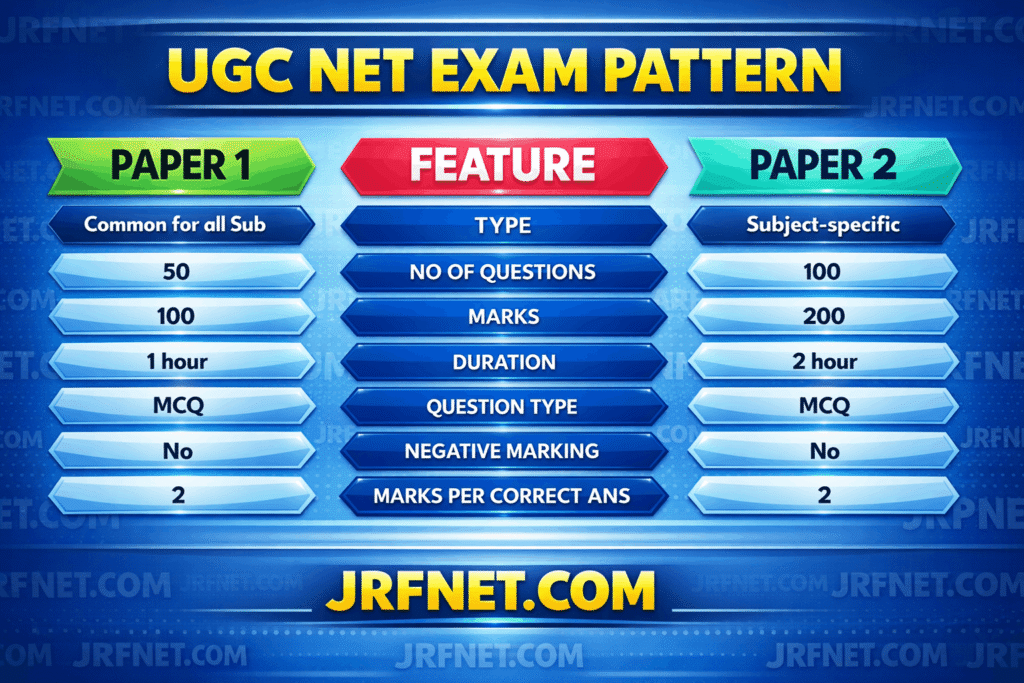
UGC NET is a Computer Based Test (CBT) with two papers in one single sitting. There is no break between Paper 1 and Paper 2, so your speed + selection of questions matters a lot.
UGC NET Exam Pattern Snapshot
| Feature | Paper 1 | Paper 2 |
|---|---|---|
| Nature | Common for all subjects | Subject-specific |
| Questions | 50 | 100 |
| Marks | 100 | 200 |
| Total Time | – | 3 hours (180 minutes) for both papers combined |
| Question Type | MCQ (Objective) | MCQ (Objective) |
| Marks per Correct Answer | 2 | 2 |
| Negative Marking | No | No |
Paper 1 (General Paper): What exactly is tested?
Paper 1 is designed to test your teaching & research aptitude, plus skills that every future assistant professor should have:
- reasoning ability
- reading comprehension
- divergent thinking
- general awareness
Paper 1 syllabus in one line
Paper 1 has 10 units (Teaching Aptitude, Research Aptitude, Comprehension, Communication, Mathematical Reasoning, Logical Reasoning + Indian Logic, Data Interpretation, ICT, People & Environment, Higher Education System).
Exam Point of View: Paper 1 is not “easy marks” if you go unprepared. It’s a paper where smart students score high because concepts are repeated in PYQs with small twists.
Click here for Paper 1 Tutorials
Paper 2 (Subject Paper): What exactly is tested?
Paper 2 is fully based on the subject you choose (your domain). It checks depth + accuracy + conceptual clarity.
Exam Point of View: Paper 2 decides your final rank more strongly because it has 100 questions (bigger weight in total score).
Marking Scheme (Very Important)
- Each question = 2 marks
- Correct answer = +2
- Wrong answer = 0 (No negative marking)
- Unattempted / Marked for Review (without final answer) = 0
PYQ Strategy Tip: Since there is no negative marking, you should attempt maximum questions—but do it smartly:
- First attempt: sure-shot questions
- Second attempt: elimination-based questions
- Final attempt: educated guesses (only where at least 2 options are eliminated)
Time Management Strategy (Mentor Style)
You get 180 minutes total for both papers, so don’t treat it like “Paper 1 = 1 hour, Paper 2 = 2 hours” as a strict rule. It’s a combined timer.
A practical approach many toppers follow:
- Paper 1: 45–60 minutes (depending on your strength)
- Paper 2: 120–135 minutes
- Last 10 minutes: review flagged questions + quick corrections
In Real Life: In CBT exams, the biggest score drop happens due to over-spending time on 5 tough questions. Learn to skip fast and come back.
What to Prepare First (Most Scoring Plan)
If you are starting now:
- Paper 1 high-return units first: Teaching, Research, Logical Reasoning, DI, ICT
- Parallelly build Paper 2 with:
- concept notes
- PYQ mapping topic-wise
- 2–3 mock tests per week (later 4–5)
Exam Point of View: UGC NET repeats PYQ concepts often, but changes the language. So don’t memorize answers—understand the pattern.
FAQs (Common Doubts)
Q1) Is there negative marking in UGC NET?
Answer: No. Wrong answers have no penalty.
Q2) Are Paper 1 and Paper 2 conducted separately?
Answer: They are conducted in one sitting with no break, under one combined duration of 3 hours.
Q3) How many total questions and marks?
Answer: 150 questions for 300 marks (50+100 questions, 100+200 marks).
Key Points – Takeaways
- Two papers, single CBT session, no break
- 150 MCQs, 300 marks, 180 minutes
- 2 marks per correct answer
- No negative marking
- Winning formula = PYQ analysis + time strategy + high-attempt accuracy
If you find any mistakes in this article, please let us know through the Contact Us page. We’ll try to correct them. Thank you.